

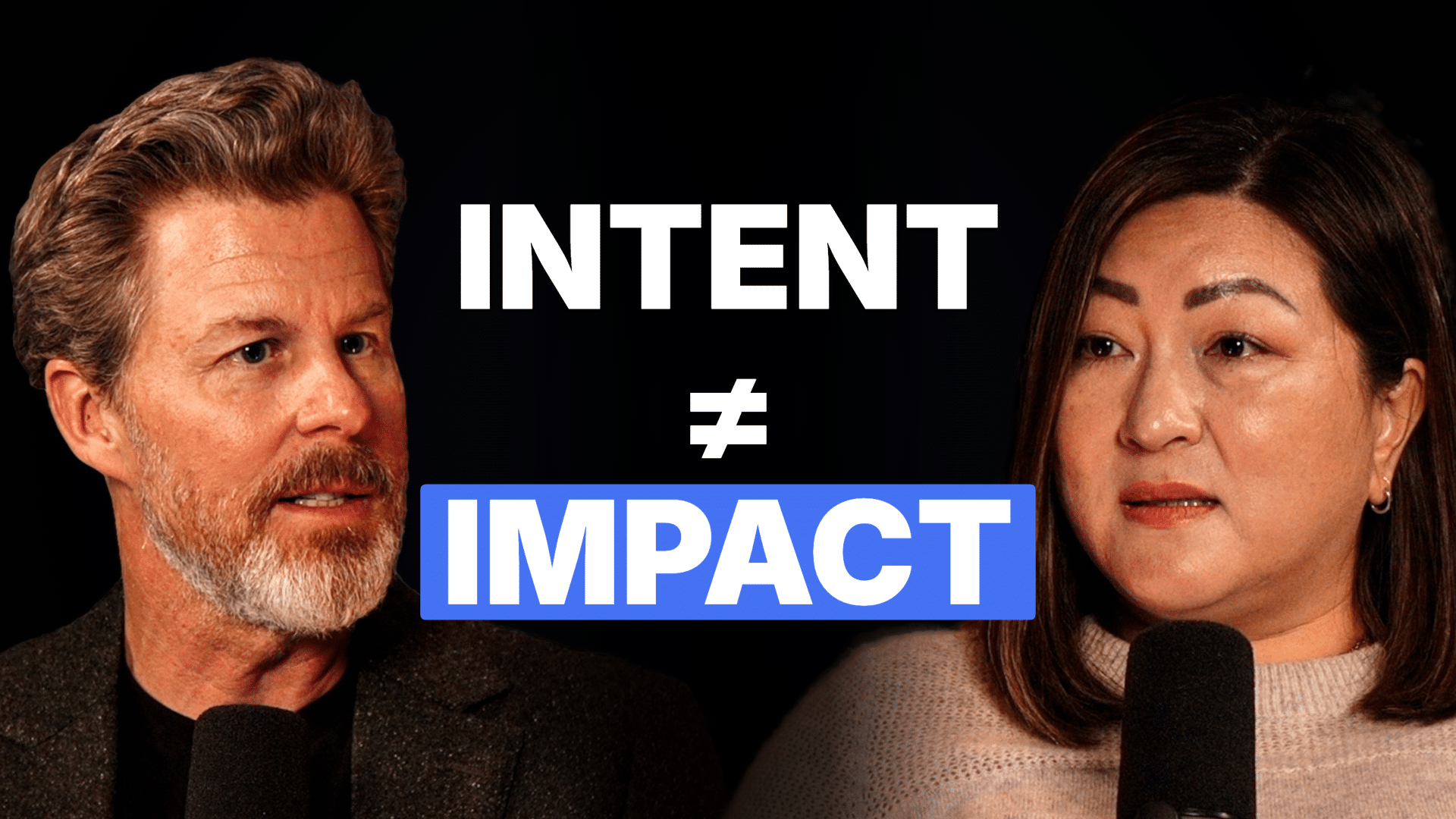
Most conflict doesn’t start with bad intent. It starts with the gap between what you meant, what you did, and how someone else experienced it.
In this episode, Shaun Dyke sits down with Stephanie Au to break down a framework called Intent → Behavior → Impact.
They also cover why leaders walk away thinking “that landed great” while their teams walk away resentful, why “advertising your intent” changes everything, and how to take ownership of the felt experience you create at work and at home.
In this conversation, you’ll hear:
• Why only about 10% of people effectively clarify intent and check for understanding, and why that gap is the one DoorTwo gets hired to fix
• A CEO whose post-COVID return-to-work mandate was meant to drive engagement and instead drove badge monitoring, resentment, and disengagement
• The exact language to “advertise your intent” before a hard conversation
• How confirmation bias and fundamental attribution error trap leaders in a story they don’t realize they’re telling
• Why this is a skill, along with the smallest, low-risk way to start practicing it this week
If you’ve ever walked away from a conversation thinking, “That’s not what I meant,” this one’s for you.
______________________________________________________________
▶ Watch the full In the Arena series: In The Arena with DoorTwo Podcast
📬 Get our weekly leadership newsletter: DoorTwo Leadership Newsletter
🏢 Learn more about DoorTwo and our work: DoorTwo.com
00:30 Shaun: Today, we’re talking about why people misunderstand you, even when you mean well. Because most of the time, conflict doesn’t start because someone had bad intent. It starts because there’s a gap between what you meant, what you did, and how someone else experienced it. That gap shows up at work, at home, in leadership, in parenting, and in the conversations that matter most. In this episode, Stephanie and I break down intent, behavior, and impact. We talk about why your message may not be landing the way you think it is, and how to advertise your intent so people actually hear what you mean. So if you’ve ever walked away thinking, “That’s not what I meant,” this conversation is for you. And if you want additional context, examples, and practical ways to hold up a mirror to yourself, subscribe to our newsletter. To subscribe to the newsletter, go to doortwo.com/signup. We share more insights and tools there each week. All right, let’s get into it. Welcome to In The Arena. My name is Shaun Dyke, managing partner of DoorTwo. Look, here’s the question we get to start with today. Do you ever feel like you are always saying the right things, but you are getting the wrong result? That’s the focus of today. Joining me today, Stephanie Au. Incredibly good to see you. But, oh, interesting.
02:03 Shaun: That’s a good point. Stephanie Au. I don’t know how much longer we get to say that, because there’s a shiny object on your finger. What happened? Did you trip and fall into a ring, or
02:13 Stephanie: It kind of was like that. I’m engaged.
02:17 Shaun: Congratulations
02:18 Stephanie: Thank you very much. Yes, to a wonderful man that I met in middle school.
02:24 Shaun: That’s insane.
02:24 Stephanie: Yeah, isn’t it? Saw him in line while I was trying to get my class schedule, and immediately thought, “He’s going to be in my life.” And here he is.
02:37 Shaun: That’s incredible. I do think before we got on, you said anybody listening is invited to the wedding. So that’s it. It’s full.
02:43 Stephanie: Yes. And the ticket is 1,000 bucks a person.
02:47 Stephanie: Yeah. Wedding’s paid for.
02:49 Shaun: Nice. We’re done. See?
02:50 Shaun: That was easy. That was a great tee up. Brilliant. I think Steven is an incredible guy. And I think you got lucky, but I might think he got a little bit luckier. So he married up, or is getting ready to marry up.
03:02 Shaun: That’s amazing. Amazing. So I bet we might have some stories about Steven in this conversation as well. That tee up of if you’re thoughtful, you’re intentional, you’re trying to say the right thing to somebody, but it’s just not the outcome that you get. That is really kind of one of the core focuses of today, and I think what we want to try to do is if you’re that person listening and this does happen to you, in the course of 30 minutes, we’re going to help solve that problem for you. That’s the plan. So why don’t you, if you will, sort of tee us up on the, how this idea of trying to be intentional about what you say, but not getting the result that you want, what do you mean by it? And then will you do me a favor and will you link it into this idea of our perpetual message set that all growth starts with self-awareness?
03:52 Stephanie: Sure. So we often teach, the model intent, behavior, and impact. So what happens is we know our intent of the conversation, the experience, the announcement that we’re trying to make as leaders, and we behave a certain way according to our intent. So what happens, though, is if there’s no one to actually provide the mirror for us, is people observe our behavior and they translate that to the impact that it has on them.
04:27 Stephanie: They do not understand the intent, and oftentimes the intent doesn’t match the impact. And that’s where we get to come in and say, “Hmm, did you mean to do that?” Or, was there a different intent? So oftentimes leaders leave the conversation going, “Oh, that went really well.” And then a few days later they find, ooh- that was not the experience the team had.
04:55 Shaun: Okay. So simple frame around this, and I think this is really powerful, because it does consist of three words. It is a very straightforward It’s not overly complex to grasp, but I think it has massive implications in your personal and professional life. We have an intention
05:09 Shaun: Normally good. The vast majority of us don’t wake up thinking, “what? I’m going to go into that situation and just blow it up and break things.”
05:16 Shaun: “And I want them to misread me.” That’s that’s rarely our plan.
05:20 Shaun: We have an intention, a behavior follows from that, and then there is an impact we have. And you said something, so we’ll just
05:28 Shaun: Explore a little bit. You said, “Through their interpretation,” and we often talk about this confounding reality that all behavior is interpreted. So if I don’t know what your intention is, I’m going to listen to the words, look at the behavior, and I’m going to interpret that. Fair?
05:47 Stephanie: Mm-hmm. Yeah. And how you, how you, quote-unquote, “made me feel.”
05:53 Stephanie: Eh, then that lens gets added to the emotional context of it all. Then I’m going to say, “Well, his or her intent was-” usually negative, fill in the blank.? And oftentimes that’s not the case. So we teach that there’s ownership on both ends. So the leader has to say, “Hey, how did that land for you after the message?” And the recipient also probably says, “Mm, I’m curious about your intent because here was the impact on me.”
06:23 Stephanie: So when both parties own that, the experience, the conversations are just going to level up.
06:29 Shaun: You and I and the rest of the firm, not only get to work in this space all the time professionally, we also navigate it personally. Just we’re going to throw a completely random number at it. What percentage of the time would you say people are effective at clarifying their intent and the receiving audience is good at ensuring they
06:51 Shaun: Relay what they heard and/or seek clarity if they think there was confusion?
06:55 Stephanie: 10%. That’s why we’re employed.
06:57 Stephanie: So
06:58 Shaun: It’s one of the core reasons
06:59 Stephanie: One of the core reasons, and leaders justify their intent, the team lives with the experience. And ultimately you got to own the experience. We say part of your job as leaders is managing perceptions of others. That is why climate is part of that, is the conditions you create for people to show up, do their best work, and it’s that perception. It’s the perception of your behavior. So, an example for you, after COVID
07:30 Stephanie: We had lots of organizations do this differently, return to work. So some full on five days a week.
07:37 Shaun: Yeah. This was
07:38 Stephanie: Some version of hybrid. Some not at all,. And, we had an organization where the CEO was looking for, people to return to work hybrid, and there were suggestions, requests, and people weren’t doing it. So then what happened? Then he said, “what? I’m just going to start monitoring it. We’re just going to reinforce it. It is now a command or instruction.” And they were looking to monitor badging in and badging out. They were also wanting HR to report out which par- which teams are coming in and not coming in and making decisions based upon that. So what was his intent? His intent was engagement. The impact, though, people were not engaged actually. They got the opposite. People were resentful at worst, frustrated, feeling controlled, and micromanaged.
08:29 Shaun: The complexity in this, and this is language you and I talk about all the time, so we talk about this idea of climate, that macro subset of culture, and that one of the constructs in that is this idea of conformity. When there’s some process or approach, inside of a system that people actually just don’t understand why. They feel like it’s non-value added- to the process.
08:50 Shaun: Does this link to that point for you on while we actually know that CEO well- and we know the intent was rooted in the right things- it didn’t show up that way. So it created ample doorway for interpretation. Do you think that’s what happened? It became
09:09 Stephanie: Absolutely
09:09 Shaun: Perceived as conformity?
09:10 Stephanie: Absolutely. Conformity. If we had pulse climate for the organization then, conformity would have went up, which then has the reverse effect on the other climate dimension, which is responsibility. It’s what he was looking for, raising standards and responsibility, engagement, and that went down. People actually actively disengaged because they didn’t appreciate the approach.
09:34 Shaun: I’m going to bait you purposely. So it was the CEO’s fault?
09:36 Stephanie: Well, yes and no.
09:38 Stephanie: ? Because if we talk a lot about followership- and part of followership is showing up in a way that you’re supporting your leader. So if we were coaching the org, we would say, “Hmm, how would you show up better for your leader?
09:57 Stephanie: What would you do differently?” Because people aren’t perfect. You could give the benefit of the doubt, generosity to what he was trying to do- and what was his goal. And so people
10:12 Stephanie: We’re generalizing, some people did that. Many didn’t.
10:15 Shaun: Yeah. So it’s a duality, right? In an ideal world, and this goes to everyone listening or watching, we’ve all been in a spot where our approach we thought was well considered. We thought we had a plan with what we were going to say and the message we were going to convey, and we did that with the best intent we knew how, because we believed that was going to get us to the outcome that we wanted. And then it didn’t. So could he have done that better? Of course.
10:44 Shaun: Now, the receiving audience in that space
10:47 Shaun: We need to ask them to bring courage present. We need to ask them to bring candor present, and we need to ask them to be willing to seek clarity, to push back, not to become defiant. Why? Anger. And you and I know this quite well, right? The, as soon as change is introduced, fear, loss, and doubt dominate thinking, and panic sets in inside of that. Do you think most people, when they don’t get the result that they want, move to ownership or move to blame?
11:16 Stephanie: Oftentimes they move to blame and justifying their intent, and that’s why I said earlier is we often gravitate to justifying our intent. And the question we want or we often ask is, what did?
11:31 Stephanie: When you want to understand the felt experience of the individual, and the real question is, what did they experience? Not, what did? So you become more other-oriented in the process.
11:44 Shaun: That’s such a, that’s actually a really great point. So gosh, there’s four vantage points I want to think about. One is the sender. The other is the receiver.
11:54 Shaun: And then I want to think about professional and personal. Because my assertion would be, and please expand if you want to, my assertion would be that we actually oftentimes are more intentional and thoughtful in professional environments, and we may get a little looser in personal environments, and we may not be as good at advertising it, pr- creating more of a potential opportunity. So I guess I’d ask you the first two.
12:18 Shaun: For someone listening, and they run into this spot often that they say, “Yeah, this happens to me. I feel like I’m trying to be really intentional, but I’m just misunderstood or it’s misinterpreted.” Then on the flip side of it, if I am the receiver, what counsel do you have for the sender, what counsel do you have for the receiver when trying to ensure we have clarity of intent, behavior, and impact?
12:42 Stephanie: Yeah. So I would say, in general, for the sender, you want to advertise your intent, and then check at the end of the conversation, “Hey, did that land or did it not?” ‘because it might not have. Because it shows that you do care and you’re other-oriented. For the receiver, check back in. It’s “Hey, this is how it landed for me. What was your intent?” So that you’re both taking ownership and meeting each other in the middle. So I’ll give you a personal example. My ex, we often say, we are our careers. And so attorneys can maybe ask too many questions of their spouses.
13:23 Stephanie: It sounds like they’re interrogating them. And, people who are, quality folks, they tend to find the flaws- in the situation. And for us, as coaches, we tend to advise, unsolicited aid and advice- to our spouse. So my ex would often share something, and I would guide and coach. That’s not what he was looking for, and he would say to me, “I don’t need a coach, I need a wife.”
13:51 Stephanie: ? And so in those moments, he wasn’t looking for that. I was just looking for support and cheerleading him on. The funny thing, though, is now that we’re not married anymore, he calls me for advice.
14:02 Shaun: Well, that’s a smart man.
14:03 Stephanie: Yeah. But that’s the, that’s the receiving, when you’re not ready to receive the advice. But now that our role is different, he wants the advice.? So that’s what I would say. It’s like if both parties take ownership and give each other benefit of the doubt, it’s just going to help the interpretation of the behavior.
14:20 Shaun: You and I use this phrase all the time, because we just said there are two realities. One, all behavior’s interpreted. And oftentimes there’s a misinterpretation between intent and impact. So we’ve used this phrase constantly of advertise intent.
14:32 Shaun: What does that mean and what does that look like? ‘because it can sound well, how do I do that?
14:36 Stephanie: Yeah. So it could sound like this, “Hey, I really want us to be successful together, and so my intent of this conversation is to really understand your perspective and point of view. So if I ask questions, it’s just from that space. Please don’t interpret it as me trying to question your decisions or questioning your thinking.”
14:56 Stephanie: “And then at the end, check to say, ‘Hey, did that land okay? Did it, did my questions come across judgmental or did you interpret it the way I intended it to be?’”
15:06 Shaun: Outstanding. It’s funny, because I would say that, when you’re initially trying to, practice disrupting this fracture between intention and impact
15:16 Shaun: It can feel a little, uncomfortable- or it can feel like you’ve not worked in that space before. And we always talk about, find your words, find your lane on how you- want to approach this. And when you and I teach, we oftentimes say to the room, “Our intention is to help you understand the content. Our intention is to help the light go on for you. Our intention will never be for you to feel like you need to defend yourself.” “And if we did that, then we handled it poorly.”
15:43 Shaun: “Please come to us on this.” So we explicitly advertise- what our words are attempting to do. And we create a space for them to say, “May we ask you to be courageous enough to say it to us if we’re doing it wrong?”
15:56 Stephanie: Yeah. You’re creating safety. And also, when you do it that way, you’re, you’re helping with the defensiveness, because you’re already taking accountability up front, and so you’re inviting people to show up differently- when we do that. So that’s absolutely I’m glad we practice what we teach
16:15 Stephanie: Our clients to do. And this Hey, this translates to parenting also,?
16:22 Stephanie: It’s, that’s just a big one. When we bring this up with our clients, they give you this look “Oh, yep, that, I do that,”? And it’s, your intent is to help your kids. You want them to be happy and successful. So when they tell you what they want For example, I had a client where his son was really good at basketball, so thought, “what? I’m going to, get a scholarship and play professionally.” So he went out of his way and did everything. Found the school, talked to the coach, laid the whole path for this kid. And at the end, the kid, the kid didn’t want to. He didn’t want to show up. And I asked, “So what do you think happened there?” And he said, “Well, he didn’t want to disappoint me. He just felt a lot of pressure from me.” So that was the experience. And so this dream no longer became the son’s dream. It was the father’s dream.
17:14 Stephanie: ?
17:15 Shaun: Intent- impact misalignment. You said something I want to circle back to that I think was really powerful. So we have the idea of advertising intent as the sender. You had then said, in an ideal world, that sender at the end of that moment, asks, in essence, “Did that land? Did that Did what I wanted you to hear, did you hear that?” And they create the space for that to happen. Sometimes that doesn’t happen. And in those spots, we encourage the receiver in that if they don’t get it, or
17:49 Shaun: Even if they think they get it, the power in saying, “Hey, so am I understanding you correctly? This is what you are saying.” So that if there’s a felt gap in that, the person gets to say, “Oh, heavens no. That No, that’s not what I meant. I didn’t mean that head space.” Which happens a lot. You and I talk about-One of the greatest ways, if you’re the receiver of a message and you feel like the message is
18:19 Shaun: Anything other than optimal, it’s off, it’s abrupt, it’s a little bit weird, we use the technique of request of channel in communication. And as the receiver, you get to ask them, “Hey, may I ask your intent?”
18:32 Shaun: “you shared that with me because ” And creating the space to ensure clarity is there, so the ownership shifts to the receiver in that space.
18:42 Stephanie: Yeah. And most people, this is a skill- people don’t have. So when we work in teams, what tends to be highly effective is we’re live coaching that process. So when we’re hearing and we’re watching this leader have great intent- and the behavior is not so wonderful, we pause the conversation, don’t we? And we say, “Oh, hold on. May we ask what’s your intent?” So we help the process. And then we say, “Hey, was that clear? Did that land well?” And they ultimately build the skill, and then we, and then we don’t have to sit and live coach the conversations anymore. It is a skill. You can’t necessarily be great at it, even if you are courageous. So having someone help you through the process is often, what’s encouraged.
19:27 Stephanie: Unless, you’re, you’re, you’re really good at being effective on your own, which is rare.
19:33 Shaun: Which is uncommon, yeah.
19:34 Stephanie: . And so that has worked for us- when we are involved with teams.
19:39 Shaun: If memory serves me, the definition of a skill is a learned or acquired ability. And so you need to build capability in that space.
19:47 Stephanie: Mm-hmm. Mm-hmm.
19:47 Shaun: You It is harder, but if as we opened this episode, if you’re frequently finding yourself in a spot where you’re trying to say the right things or you think you’re saying the right things, but that’s not what’s happening, you’re not hearing it that way, well, then perhaps it warrants us to amplify our capability in that space. And as the receiver in those spots, the power in creating a space for increased clarity.
20:10 Shaun: A fun one to think about for us, a couple psychological constructs. Confirmation bias.
20:17 Shaun: I have a view of you. Fundamental attribution error. So let’s chase confirmation bias first on, how do you think that affects this intention-behavior-impact chain?
20:29 Stephanie: In a lot of ways. So there’s, there’s another component of, as a leader, there’s, there’s a concept of power distance.
20:37 Stephanie: The higher up you go, the less feedback you receive. And it’s also filtered feedback. So it adds to this confirmation bias. So this leader goes to a person that they think they trust and say, “Hey, did that land?” And this person’s like likes this individual, likes the leader, would say, “Yeah, it absolutely lands.” So they ask one person out of 10, and they’re “Oh, what? It absolutely, was effective. I was, I was good ‘because this person said so.”
21:03 Stephanie: Now, that’s not the right question. The right question to ask is, “How could I have been better?” versus, “Did that land?”
21:10 Stephanie: Or, “Was I effective?” Because then they will offer up a tweak for you. And if this individual really likes you, they’re going to filter you through a positive lens. So you probably want to go to a person that maybe is- more skeptical of you. And it, and it works the other way too, which is, if that person is skeptical of you, same person, same meeting, will filter that conversation as negative.
21:33 Stephanie: ‘because it’s “Oh, see? See? I said she would be very controlling, and that’s what I heard.” Versus the other individual would’ve heard something different, right? “Oh, she’s always so clear.”
21:43 Stephanie: “And that’s what I heard.”
21:44 Shaun: With confirmation bias- we’re going to reinforce our- perspective of what we have on you. And so- unfortunately, we have that potential where, this false narrative just gets stronger and perpetuates even more. One of our partners, Susan, is phenomenal any time you work with her. At the end of that event, she says, “How could I have been better for you?”
22:02 Shaun: It’s a literal invitation into- providing guidance and feedback in it. Let’s talk fundamental attribution error. I remember when I first got exposure to this. It was actually in Chip and Dan Heath’s book, Switch. And the general concept behind fundamental attribution error is we assign the fault of a behavior we’re seeing to a fundamental flaw in the individual. They’re a bad person. They’re rude. They’re mean. They were, raised poorly. Versus an environment or other scenarios that could be conflating the response that we’re getting to them. So if I’m the receiver in that space, and I already have this fundamental attribution error in play about how I’m thinking about the sender- what’s that going to do to my interpretation?
22:47 Stephanie: You’ve already made a decision- before that person even spoke.? So it’s harder for that leader, isn’t it, when you have that. And so we often say, though, relationship is moment by moment, conversation by conversation. So if this leader is aware, they would probably know that there’s some distance in that relationship, and how do I close that distance?
23:10 Stephanie: And that’s difficult because sometimes it’s also, we have emotional blind spots- where we’re unaware of what we’re saying, especially with managing change, ‘because we do this all day long, don’t we? We coach and guide leaders on change navigation. They do not correlate the emotion with the change when they introduce it, partly because they’ve already gone through their process and their emotional state, and the other is they don’t understand the experience of this change for the individual.
23:43 Stephanie: And so they’re “Oh, okay, I’m going to go in, announce this big change. Sounds like that went pretty well. I didn’t get a lot of questions.”
23:49 Stephanie: They didn’t realize that everyone’s in shock.
23:52 Shaun: They’re on board. No, they’re not. Yeah.
23:56 Stephanie: And they do it too quickly also.
23:58 Shaun: Yeah. Yeah.
23:59 Stephanie: Which is, which is another component of it.
24:01 Shaun: ‘because they’ve already worked through that emotional process around it.
24:05 Shaun: Gosh, this also hit me really hard when I, when this message anchored years ago. It was, a decade ago, someone said to me, “People will not change until you allow them to.” linkage into confirmation bias. If I choose to hold onto a perspective of you that I’ve, I’ve either rightly or falsely formed, in my eyes, I don’t care what effort you’re going to put into this, how much you’re going to attempt. If I choose to hold on to the vantage point that I want to hold onto about you, then in my eyes, you’re never going to change, and that’s a me problem again. That’s not a you problem.
24:46 Stephanie: Yeah. Yeah. We have a lot of that where, I’m thinking of a situation where I’m doing a 360 for this leader, and I come back and reassess every year. There’s a couple of folks in that 360 that still hold onto that, “Hey, in that one meeting, he still was sort of loud.” Out of 20 meetings, that, it’s that one meeting you see, he’s still the same person. And I say, “But there’s that 19 other meetings that he’s been different.” And then, out of the 20 people I spoke to, those two hang onto that. The other 18 are “I’ve seen massive progress.” So then it becomes, ugh, these two individuals are choosing to, like you said, confirmation bias, hold on to history.
25:30 Shaun: Let’s, let’s bring it back to if I am the leader or if, not even the leader, if I’m the sender of a message- so that could be to my kids- that could be to my spouse, that could be to somebody at the rental car counter.
25:43 Shaun: Part of the initial approach is to advertise intent. And so this looks like me as gracefully as possible saying, “Hey, here’s my intent.” I think of an example that I use all the time in the firm, those that know me know that I verbally process a lot- and I have to be conscious of that, otherwise I’m talking something through, and someone can think it means to action. So I will, now, I can just shortcut, and I can say verbally processing. Which means I’m advertising my intent here.
26:09 Shaun: I’m just talking it through. I’m not trying to get to that outcome. So for the leader or the sender of the message, the recommended first step is to embed this idea of advertising intent. Is another way of saying that is just saying what your goal is?
26:23 Stephanie: Yes. Yeah. Yeah. My goal of this conversation is
26:27 Shaun: This.
26:27 Stephanie: ? Yeah.
26:28 Shaun: I don’t have to be formal- and say, “I’m going to advertise my intent right now.”
26:32 Stephanie: You don’t sound that way, by the way.
26:33 Shaun: I don’t. I never sound that way, yeah. Never. Sometimes that gets me in trouble. So advertise intent, a high-value message for the sender. Second high-value opportunity for the sender is once the message has been sent, is to ask if the intended message is what was received.
26:50 Stephanie: Yeah. Mm-hmm.
26:52 Shaun: They say no, you get an opportunity to go at it again.
26:54 Stephanie: That’s right.
26:56 Shaun: What’s the shortcut or the guidance for the receiver in a message?
27:01 Stephanie: If they observe a behavior, and it doesn’t land well with them, then they can say, “Hey
27:10 Stephanie: Can I check on your intent? Because the impact on me was X, and I don’t think that was your intent.” We’re assuming it’s negative.
27:19 Stephanie: Can I, can I ask you, because I do care about our relationship, and I assume that’s not what you want. That was super helpful for any other leader or person to hear because sometimes they’re not aware.
27:32 Shaun: Steph, all of these things, so valid, and as we talk about them, one of the things that I’m really conscious of is this idea of curse of knowledge. When you, when the things, it seems really simple. If someone was trying to teach us the luge, they know all about
27:46 Shaun: The luge. I’ve never luged before. It would take me a minute. And the frequency with which consultants in the firm hear, “Would you say that again, and can I record it or can I write it down?” Because we live in this space where our goal is to amplify impact and influence through communication, written and verbal. So we think about this a lot. So you and I kind of think can sort of naturally drop into this space that says, “Let’s advertise intent. Let’s check for understanding.”
28:15 Shaun: If I’m the receiver in that space, let’s walk through the doorway that says, “I think your intent was X. May I clarify that?”
28:23 Shaun: That’s hard. Fair?
28:24 Stephanie: It, yes.
28:24 Shaun: That takes a minute to get a grip on. What we’re talking about is oh, just activate these simple tools.
28:31 Stephanie: Yeah. Yeah.
28:31 Shaun: What’s the counsel you give to somebody that’s listening that says “Gosh, I’m in a spot right now. I’m oftentimes trying to convey a message to people, and I think I’m doing the right thing. But I just feel like my team’s being resistant, or they don’t want to hear it, or they’re gaslighting me, or they’re in a spot where they’re blaming.”
28:47 Shaun: Or the vice versa of that. Sure, that’s a great idea, Stephanie, but I’m a manager, and when the vice president’s talking to me about something, I don’t feel like it’s appropriate for me to stop them and say “Can I clarify your intent with that message?” What do we say to those folks?
29:01 Stephanie: I always say, “Hey, start small, start simple.” start with someone that you think will give you feedback honestly, and start with one conversation.
29:10 Stephanie: And so when you’re about to have that conversation, be intentional about your intent, plan for it, and do that, practice it with this individual. And then say, “Hey, I’m learning a new skill. How did that land for you? Did it work?” And you got to hear yourself talk sometimes. And then it becomes more natural the next time. Before you tackle a trying relationship, you really want to start with something else that’s more simple for you to practice and that you’re psychologically safe so you can then be yourself.
29:41 Stephanie: If there’s already emotion involved in that relationship, it’ll be harder for you- to try something new. And I think that you want to plan for these things. Sometimes leaders move so quick that they don’t plan. So you want to say, “Hmm, in this meeting, I’m about to announce a change. How do I want the people to experience this conversation? And based upon that, then I want to behave this way, and I’m going to choose these words.” And plan for it. Write it down. Practice it. I guarantee you it’s going to go better- when you do it that way, it, ‘because that’s matching your intent- with the impact you’re about to have because you don’t think about the impact first. You think about the intent and your behavior. And you’re going to assume people are going to have the impact that you want them to have.
30:31 Shaun: All growth starts with self-awareness, right? So how, as we as individuals navigating this world, one human in a great big pile of humans- am I taking stock of- the degree to which I do this well? Do I know if I’m having the impact I want? Do I assume that I’m having it? Have I created a degree of arrogance where I just expect people to understand it? There’s a version where it’s take stock of those.
30:53 Shaun: We then also say that all leadership, personal, professional, in those various different constructs, is the skillful use of influence. So if I want to amplify my ability to have influence and land with impact, my ability to advertise my intention, check to ensure that my message set landed
31:13 Shaun: Greatly affects the collective outcomes that I have. I’m not spiraling people. I’m not spinning them in the wrong direction. I’m not requiring mass degrees of interpretation. There’s really It’s an incredibly powerful tool to accelerate your ability to have impact.
31:27 Stephanie: Absolutely. I’ll give you a positive example. There is a leader that I coach. She was announcing a massive org change, which means many people will be impacted. Fear is always heightened when that happens.
31:44 Stephanie: She put a lot of thought and prep into this town hall that she was about to have, and she was wonderful. Part of it is also being vulnerable, a behavior you’re choosing so that you create the right experience, not over-advertising to people the goodness in it. And being really raw and real instead of sugarcoating. And she did that. She planned for it. She stated the intent. She behaved a certain way, and what she got, she told me in her words, “I left it all on the field.” and though people weren’t happy to hear the news, they understood it. So the impact was exactly what she wanted.
32:23 Shaun: Powerful. Incredibly powerful. And by the way, would, I would, and I guarantee you in one guess, I would know who you’re talking about. Right? Just, she’s a rock star. I think the encouragement here is, if you’re listening or watching, start small. Start with some folks that you may be able to create trust with. Advertise your intent. “Hey, I’m trying to get better at this.”
32:43 Shaun: “And in fact, I would like to start practicing this with you. So whenever I give you feedback tonight or when I have a comment tonight at the dinner table, know that my goal is trying to just get better inside of this space.” Learning to encourage present. If I don’t understand it, to seek clarity. Taking stock where confirmation bias or fundamental attribution error may be showing up in the way that I communicate to people and the way that I receive messages that are sent to me.
33:08 Shaun: Those, I think, are some really powerful tools to help move you along this continued path of showing up in the arena and having that incredible impact that you want to have. Before we sign off, we’ll just clarify again, everybody’s invited to your wedding, so that’s awesome. They can just all show up. $1,000 per ticket.
33:27 Stephanie: That’s right.
33:27 Shaun: Yeah, sure. And that may go up probably
33:30 Stephanie: Well, oil is going up and gas is going up.
33:31 Shaun: That’s right.
33:32 Shaun: Geez. A whole other conversation inside of that. Thanks for bringing that one up right now.
33:37 Shaun: Any final sort of parting message sets that you want to convey to folks around this really powerful concept of intention, behavior, and impact?
33:46 Stephanie: Yeah. I would say, intent is all well and good. We often have good intent. It’s the felt experience that people live with that we got to have ownership on.
33:57 Shaun: It’s powerful. I just gave a keynote and I said, “If you want to take stock of this, you can intend to be a good parent.” And it is the felt experience of your children that will determine whether or not you’re being a good parent. It’s the same thing as a leader. At the end of the day, intent, I understand it’s a powerful thing, but the felt and the lived experience of those receiving what you wanted is really what determines whether or not those outcomes are going to get where you want.
34:22 Stephanie: And if you take this and you truly own intent, behavior, impact at home and at work, I guarantee you your world is going to change.
34:30 Shaun: Yep, fundamentally.
34:32 Shaun: You and I don’t get to spend enough time together.
34:34 Stephanie: Right?
34:34 Shaun: We usually spend it sitting here in these chairs half the time. So thanks a ton. Appreciate it, and looking forward to the next time we get to do this.
34:41 Stephanie: Love it. It’s always fun.
34:42 Shaun: Sounds great. Yep. See you.