

So many people are exhausted, overloaded, and trying to push through each day on empty.
We’re living in a culture that rewards grinding, reacting, and always staying “on”, but no one ever taught us how to take care of the one thing that makes everything else work: our capacity.
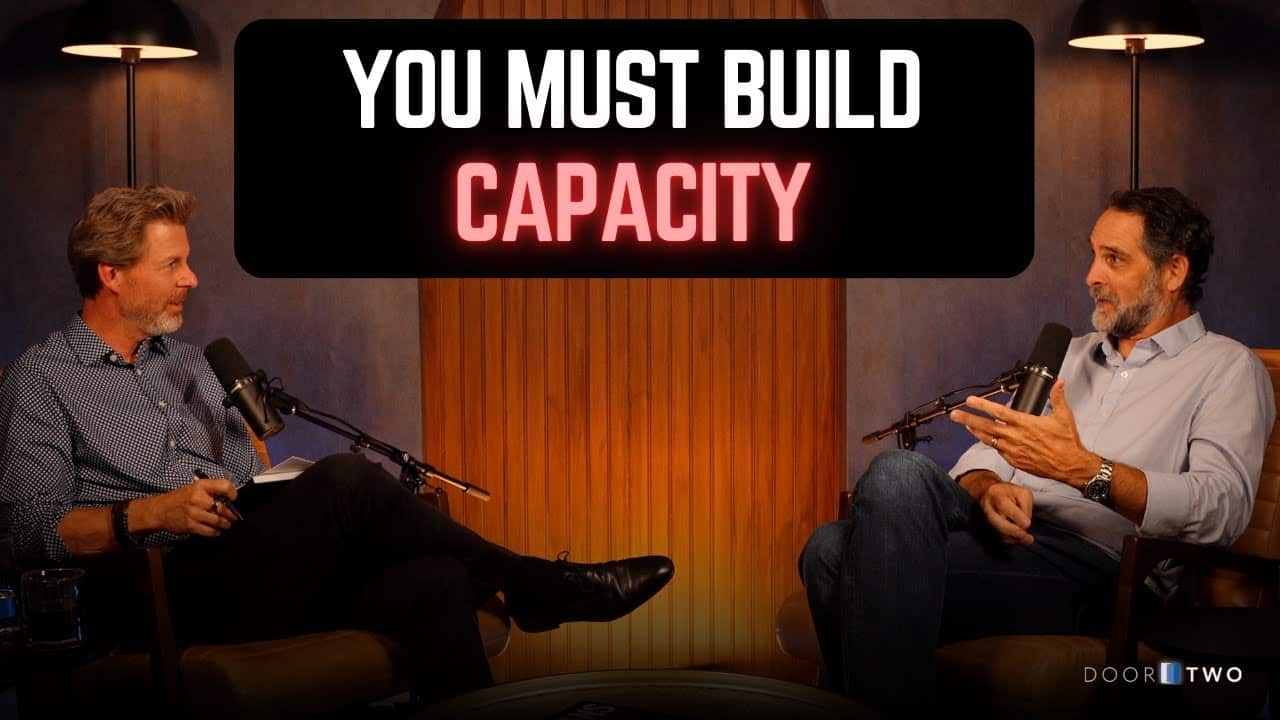
In this episode, Shaun Dyke and Jeff Miller break down why exhaustion is showing up for so many of us, why skills and effort stop mattering when you’re burned out, and how a few simple daily habits can help you feel more grounded and in control of your day.
You’ll take a closer look at your self-care habits, see how early ideas about productivity show up in your day, and learn why ignoring yourself never works for long.
More importantly, you’ll learn what actually helps; practical, repeatable habits that support your energy, attention, and overall well-being.
If you’ve been feeling stretched thin or stuck in old patterns, this conversation will help you reset your mornings, your energy, and the way you move through your day.
All growth starts with self awareness.
Shaun Dyke
00:00:01.200 – 00:01:45.460
Thanks for joining us in the arena today. My name is Shaun Dyke, managing partner of DoorTwo.
So look, DoorTwo in its history has primarily focused on competency creation within individuals and leaders. What does that mean?
That means skills, attributes, models, mindsets, methodologies that help us be better at leading businesses, leading our family systems, leading whatever dynamic we’re looking into.
But like many in the past few years, one of the premises that we’ve really started to understand and realize is that if we’re going to lead well, we at first we gotta be well. We need to make sure that we’re taking care of self.
A provocation that I often make is that our business wouldn’t exist if people did two things really well. The first one is if they knew how to leverage candor.
We’re not chatting about that one today, but people don’t know how to speak directly to one another, firm and kindly. The second one is self care. People genuinely and generally my provocation would be don’t do a good job taking care of themselves.
I’m joined today by one of our illustrious partners, Jeff Miller. Incredibly fun to have you here, man. I got to mine.
I’ve been very excited to have our conversation with this because I think it’s going to be fun banter inside of this. We’re both kind of dorked out on the excitement around this idea of capacity. It’s exciting.
Jeff Miller
00:01:45.460 – 00:01:45.940
Yeah.
Shaun Dyke
00:01:46.180 – 00:02:06.950
And I think you’ve done a really phenomenal job of quietly but powerfully transforming the way you protect and curate capacity in yourself. So we’re going to chase it a bit, but at least for a moment. Snapshot. Who the heck is Jeff Miller? For those listening, quick high level overview.
Jeff Miller
00:02:07.270 – 00:02:24.970
Jeff Miller, I’m a partner here at DoorTwo. Joined the firm about four and a half years ago. Prior to that I was the chief learning officer at a software company called Cornerstone.
Prior to that I was a university professor, school teacher, the whole thing. So I could bore you with the details, but I think that’ll suffice a bit.
Shaun Dyke
00:02:25.290 – 00:02:29.690
So suffice it to Say you got a little bit of knowledge in the space of why people do the things that they do.
Jeff Miller
00:02:30.410 – 00:02:36.330
I would like to think so, although we always have a lot of room to grow. But I don’t think that’s our main topic today, which is.
Shaun Dyke
00:02:36.730 – 00:03:31.220
Well, kind of. Kind of. Because I think that’s part of what we’ll chase and we’ll look at some of the ways that that drives it.
No, ours today is really about that idea of if you want to have the level of impact that you’re trying to have in life, you can amass a collective amount of educational knowledge on the things to do. But if you’re tapped out, tired, overwhelmed, depleted, exhausted, emotionally angry. Not that I. Oh, I thought that was a question. Yeah.
It’s myself as well. And not that we’re always all in those spaces, but I think the provocation that I would have is my experience as a consultant.
I think yours as well, and not only in the sphere of business, but we’ll constrain it to that for one second that as people grow in their responsibility sets, the difficulty in their job sets, they start dedicating less and less focus to taking care of self fair.
Jeff Miller
00:03:31.220 – 00:03:32.660
Would you agree 100%.
Shaun Dyke
00:03:34.020 – 00:03:37.930
And that’s a place you chase in your work with clients extensively as well.
Jeff Miller
00:03:37.930 – 00:04:10.430
Yeah. Which is interesting is that when I first started doing more of this work, I didn’t.
Why I didn’t see the value because I find that one of the key pieces when you’re doing coaching with people is, at least for me, I know for you as well, is authenticity.
And I struggle standing in front of people and saying, you should do this, knowing full well I do not do this. So I would fight pretty hard about the. Oh, this whole person coaching. Like, I don’t think so now I kind of lead with it.
Shaun Dyke
00:04:10.430 – 00:04:23.510
I think that’s one of the things that I was excited about, you and I having this conversation, because it wasn’t that many years ago that I remember sitting across the hall in the conference room and you really bumping into this idea that. I don’t know. I don’t know that that’s really what we need to do.
Jeff Miller
00:04:23.749 – 00:04:26.470
Steamrolling, steamrolling. Take your pick.
Shaun Dyke
00:04:27.110 – 00:05:15.060
And like, I guess this can feed back into some of the things that you’ve got more steep knowledge inside of. But I’ll ask it in sort of a generic way.
One of the things that we tend to say as a firm is that, you know, you’re really a compilation of the messages you’ve heard that you accepted or rejected. Right. So in general premise, somebody said education’s important and you said I agree.
And so you went to school or you said bah phooey and you didn’t go to school on those pieces. Right. And so then that were formed in that.
Well, what I’ve continued to find, and I’m curious, your vantage point on this is one of the things that contributes to whether or not people place value in this are the messages they heard around self care as they grew up. So I’m curious messages you heard around the idea of taking care of self and prioritizing that as you grew up.
Jeff Miller
00:05:15.220 – 00:06:32.200
Yeah, you know, it’s an interesting one when I think back to growing up, only child was a very competitive tennis player.
I remember one of the things that I was thinking about early in life was that I went to an elementary school and then was tested to go into this prep school and was put into this prep school which became very highly competitive, competitive in tennis.
So the messages I learned about self care were really, if I were to think honestly about it, was get up at 5 o’ clock in the morning, go play tennis, go to school, go back, play tennis, do your homework, go to bed, wash, rinse, repeat, repeat. Yeah, and so I don’t remember a lot of messages of self care about rest, about get time to sleep, about time to reflect.
I mean most of it was about be wildly productive. I grew up in the house with dad still alive, ophthalmologist, so an eye doctor.
And so his general way that he approached the world was value orientation is about producing, providing for your family. Less so about let me take care of self. Now we did vacations. I don’t define a vacation truly as self care.
Shaun Dyke
00:06:32.280 – 00:06:34.360
I agree, agree. And those happen once a year is.
Jeff Miller
00:06:34.360 – 00:07:30.680
An important escape piece. So I think that some of those messages really were work through it. Hard work will pay off Gen X.
And so I think that a lot of that really comes from that.
So it was interesting when I looked back at sort of those, those initial spaces that I was encouraged in, it was less about take care of yourself and be the best, work hard, outperform, do this. Which I think ultimately benefited me but also did not lay a really healthy foundation for me to, you know, for me to take care of myself.
In fact, you know, I’ve told you about this numerous times, but I wrote an article several years ago in Fast Company that was literally about workaholism and the fact that I had not taken one day off for eight years. And so I think that if we’re going to talk about self care, it’s why I’m really excited to talk to you about this.
Because for those people that are listening, it’s like, I’m not going to stand up here and lie. Like I was the absolute poster child of. Of poor self care. And that’s been the big awakening.
Shaun Dyke
00:07:30.680 – 00:07:45.520
I admire that in a different. A number of different spaces. Because as you know, one of the programs we run elevating capacity really around this space.
And something that I appreciated about you in the very beginning of this was your articulation of being desirous of teaching it. But there’s no way you would do it yet because you felt like a hypocrite in that space.
Jeff Miller
00:07:45.680 – 00:07:46.480
100%. Yeah.
Shaun Dyke
00:07:46.480 – 00:08:12.410
Which I think is a very different reality for that space now. But back to that space. One of the things we ask folks is really like, what are those messages you’ve heard? And we do consistently hear things like, you know, I’ll get all the sleep I need when I’m dead. Or that rest actually equated to laziness.
That the message formation was really around like grind. Like you get one chance in this life, you just gotta. On the daily. Be in the hunt all the time.
Jeff Miller
00:08:12.570 – 00:08:37.910
Yeah. Do well, succeed, get a bank account. It was not about the other half, which, you know, really feeds the rest of it.
That was a piece that we missed. But the, you know, the good part, I forgot who said it.
I wish I could give them attribution, but somebody talked about, you know, people when they talk about growing old.
They focus on the old rather than the new. And I think that’s what I like that we get to do is that we get to grow. And that was one of the epiphanies that I got to have a couple of years ago.
Shaun Dyke
00:08:39.030 – 00:09:09.790
You just created the linkage already in like how that translated into early professional life and maybe even not just early professional life, but professional life for a while. It was, it was a grind. It was a eight years without taking a day off inside of it. So turning point.
So when you think about this discovery in this struggle space, when did you start recognizing or what was that triggering mechanism that you realized? Maybe I was leaving something on the table in my productivity space. Or maybe productivity alone wasn’t enough.
Jeff Miller
00:09:12.110 – 00:09:31.150
It’s a great question. I think that if I honestly think through, I’d always had curiosity into things like yoga, never did it.
Buddhist studies, you know, I read Thich Nhat Hanh. Scanned the books. Sure, sure.
Shaun Dyke
00:09:31.630 – 00:09:34.430
So honestly admired from afar.
Jeff Miller
00:09:34.910 – 00:10:34.010
I mean, I was buying books and things and it was great, but it wasn’t like it’s effort. It was effort that was not achieving any sort of desired results.
And at the risk of sounding like I’m pandering to the audience, I think that the moment that I decided to really say I want to take this seriously, you just hinted at, which is we started talking about this capacity workshop. My immediate reaction was, I don’t know why we would do that.
And then I started to hear some of the work that we were looking at doing, did a lot more reading, found connections to stuff I’d been reading about for, we’ll just say, oh, roughly 40 years. And then I said, you know what, I’m going to give this a shot because it’s a space I would like to spend some more time in. So.
So if I were to say, like, what was the real turning point was I think when the firm decided to say like, we’re going to go with this. And I mean you said exactly what it was, which is I was like, man, I would love to teach that, but not yet.
And I think that we’re all works in process. But I think that was the turning point for me, which was I said, I’m going to at least give this.
Shaun Dyke
00:10:34.490 – 00:10:58.510
A try and correct me if I’m wrong, but I think one of the things for you was. Little Robin Sharma, 5am Club. Right.
That was one of the pieces, was a book that I had been recommended to me that I was reading that I recommended to you.
And I think what both of us said, like my comment was, you know, there’s certain parts about the narrative in it that may get lost inside of, but in truth that it’s one of the most underlined and highlighted books.
Jeff Miller
00:10:58.590 – 00:10:59.510
Lot of nuggets.
Shaun Dyke
00:10:59.510 – 00:11:12.500
Yeah, yeah, yeah.
One of the basic premises in that book that I really want us to chase is this idea of the installation of a morning routine, which I think is something that you’ve heavily leaned into. Yes.
Jeff Miller
00:11:12.970 – 00:14:18.229
Oh, I wouldn’t say heavily lean into the interesting thing.
I was talking to a client the other day and one of the things that we were talking about was just the reality of the normal morning routine for many people, which is lay in bed, open your eyes, reach over, grab your phone, check your email and start working immediately. So I think that by and large a lot of people have a morning routine. It’s just terrible and twisted.
And so yes, I did, I started to chase this morning routine. A lot of it came from Robin Sharma’s work.
I think the core of what he said was you really get this time in the morning where 60 Minutes, I think he called it the hour of power or something.
And it’s where you get up and you do some relaxation, you move your body, you read, you do something, you sort of front load your day, you hijack the cortisol so you come into the day a little bit more focused.
And so as I started to do that again, I tried and I gave up and I tried and I gave up and I tried and I gave up.
And so I think that’s if there, you know, to the people that are watching this, that’s the one thing that people talk to me about when they try to start this practice, is they give it a shot, but then they back off and quit really quickly.
And what we know, if you’ve read Atomic Habits or anything about habituation or any of the Gladwell stuff, is that you’ve got to put time and deliberate effort into this practice before it becomes habituated. And so that was where I then decided I’m going to take this morning.
And the rationale that I came up with for myself, and it’s a piece that I share with clients a lot, is how often during the day do you take time just for you to be truly selfish?
And what I took from, from 5:00am Club, I don’t know if he said it, he probably did, was that may be the only time of the day where your phone’s not going to ring, your email’s not going to be coming in normally at 5am and whether it’s 5am or 6am or noon or whatever, I think that his point was inject time and energy into yourself. And so the space that I have gotten into especially, and I know we’ll probably talk about what the morning routine is.
But the space that I found is that sometimes I’ll be in my little meditation space and my mind starts to wander and I start to think about this or that or the other thing. And my reminder literally is, dude, this is your time. You have no time for you. You have 10 minutes.
And the reality of so many people that I talk to is that they have this belief set, this heuristic that I don’t have 10 minutes, that I’ve got to run, I’ve got to rush, I’m going to miss something. And the reality is, is that what you’re missing is a time just to check in with you. And that has been immeasurably powerful, man.
Shaun Dyke
00:14:18.229 – 00:15:32.150
There’s like nine things I want to chase. One is I want to give label to something and I know your headspace in this already, so I know where you’re headed, what you think about this.
You’d made the comment on like take that moment to be selfish. And one of the things that we talk about is it’s the least selfish thing you can do. Self care is selfless when we recognize we’re doing that.
But let’s think about you a few years ago, me a few years ago, anybody. You’re in that spot that you’re listening right now, you’re like, okay, first of all, I’m not getting up that damn early. That’s way too early.
I don’t have time to do that. What do you want me to give up instead? How many times do you hear that in the coaching work that we do?
When you start talking about trying to install some sort of self care routine? Morning, midday, whenever. It is some good research around the power of morning. But.
But whenever those are installed, the vast majority of the time you just get pushback on. But there’s just no time to do that.
So one of the things we try to do is link it into, and I’m curious how much this was play for you is let’s play the tape all the way out. Right. The subtitle to our elevating capacity program is Leading for the long game.
It’s recognizing that so much of what we’re doing not only optimizes ourself today, but also better positions us to have the legacy and the impact that we want in the long run. That was a factor for you in this process?
Jeff Miller
00:15:33.750 – 00:16:15.150
I’d like to think it was. I think that the main factor of why I wanted to start a morning routine was just the chaos.
I remember when I was at Cornerstone, I was routinely working 15 hour days and I realized that I was getting out of shape. I was starting to put on some weight. I just wasn’t feeling good. And so I think that a lot of it has to do with long term legacy.
And I think the term playing the long game is huge because I have the lovely privilege of turning 60 years old next year. Congratulations, Silver Fox. Well, appreciate that.
And I think the thing that’s so funny about it is that when I was a little kid, I remember thinking 40 and 50 was old.
Shaun Dyke
00:16:15.150 – 00:16:16.550
Oh, yeah. Antiquated as hell.
Jeff Miller
00:16:17.110 – 00:16:52.770
Yeah.
In fact, I was reading something somewhere and they were asking little kids about, what do you think a 40 year old’s like, they’re like, well, they get up and they’re on their walker and it’s horrible. And I think the reality. The reality I have had now that I’m bumping up on that age is a. I feel pretty damn good, but I know I can feel better.
And you and I have talked about different issues, which, by the way, morning routine. And that kind of practice has actually really helped. But yes, long game legacy.
Being able to show up in a healthy mindset has also been immeasurably powerful.
Shaun Dyke
00:16:53.460 – 00:17:42.530
So comparable journey. I’ll give you full credit to anybody that’s listening that thinks that I’m doing it really well. I stumble through it a lot.
I mean, I’ve been off my game for a bit, but I will say that. And I think you had a similar experience with this.
Those early attempts, that installation in it were almost comical at times, like you’re trying to outsmart yourself in some ways.
And so for me, morning routine installation, I knew that when my alarm would go off early in the morning, and I’d always told myself, which was just a mental model I’d created for myself as well, that I’m not a morning person. Like, I can’t do mornings. And the realization was there was just no other time really to really optimize and do those spaces.
So I remember when I was initially trying to install this routine, it was like, I’m gonna put my shoes out and my workout gear out, and then when the alarm goes off, I’m gonna make myself get out of the bed.
Jeff Miller
00:17:42.530 – 00:17:43.610
You just felt more guilty.
Shaun Dyke
00:17:43.690 – 00:18:16.970
Oh, and I was just tired. I was just. And I learned, I told myself that I committed to. And we talked about this once before on an episode.
We talked about, oh, you can actually answer this better. Correct me if I’m wrong in the way that I say this.
I oftentimes say, when you look at the difference between commitment and motivation, motivation tends to have a positive emotion tied into it. I’m motivated to do something. Commitment is a.
Is a mental decision, an intellectual choice to do the thing, even when the drive or the associated emotional feeling state isn’t there. Yes, I would agree.
Jeff Miller
00:18:16.970 – 00:18:47.100
As you were talking, I was trying to think of what people talk about when they’re afraid of commitment. When people are talking about relationships and say, oh, you’re afraid of commitment, people don’t say they’re afraid of motivation.
The reality, I think, is that commitment can have a negative connotation, because I think that motivation may speak more to a temporary state of being, whereas commitment has More of a long term, you’re locked into something. You get a car or you sign a commitment, you get married, you make a commitment. You buy a house, you make. Yeah. So I think that there’s a lot to that.
Shaun Dyke
00:18:47.340 – 00:19:45.160
So I had told myself that I was, I was, I was investing in and I was going to get my committed to 30 days. And even then that was probably too long to try to do right.
But the cool part was like on day six, like a two story house and I realized that like as I would come down my stairs, once I was on like the sixth or seventh stair, I was fine. I was fine. I’d been awake a whole 92 seconds at that point, but I was all right.
And then I would make my way down the stairs and it was like a really consistent routine. I would feed the dog and then I would come over and I would turn on the coffee maker. I would look at the clock, it would be 5:06.
I would wait for my coffee cup to fill up and then I would just. It was just kind of the strudge. I honestly don’t remember the exact date, but let’s call it three weeks in maybe.
I’m waiting for my coffee to fill up. And I said to myself, man, I love this time. And it was just this hit of wait. But I’ve always told myself though I wasn’t a morning person.
So I’m curious for you, what did the early iterations look like? Were they fits and starts? Was it difficult, frustrating or did you find it to be easy?
Jeff Miller
00:19:46.120 – 00:19:58.240
So I’ve always been a morning person for those Gen Xers out there, you know, I was the kid that woke up in the morning. I always love telling this to, you know, younger people where when I was.
Shaun Dyke
00:19:58.240 – 00:19:59.440
A little kid, pretty much everybody for you at this point.
Jeff Miller
00:19:59.440 – 00:21:30.010
Thank you, Appreciate that. I used to wake up in the morning and I would get up and I would turn on the television.
This was when I was a little kid before I got my morning routine. Did they had tv, my morning routine? Well, it was more of a parrot inside of a box, but it was fine.
And I remember I would turn the TV on, it would be the Technicolor bars across the bottom. And then at about 5am the national anthem would play and TV would begin, start.
And then I would watch Davey and Goliath, which as a young Jewish kid watching about a Lutheran minister and a talking dog was super confusing, but it was actually really quite exciting. And so I think my morning routine is I’VE always been a morning person. So I’m the person that I.
My wife loves this about me, that I set an alarm every day, and she says, why are you setting an alarm? You’re going to get up hours before it. And so I think that for me, getting up in the morning has never been the challenge.
I think that part of the challenge has been starting a different routine.
Because my morning routine historically has been get up, slam multiple cups of coffee, get into emails at some point later, read the Wall Street Journal, read New York Times, read something, and then all of a sudden, I’m in meeting chaos. And the whole day would just feel like it was swirling out of control. A lot of my clients tell me the exact same story.
I asked them, so what’s your morning like? And they’re like, well, I get up and I check my email and I have my holy shit moment. And then I’m off and running.
Shaun Dyke
00:21:30.010 – 00:21:30.890
Anarchy ensues.
Jeff Miller
00:21:31.370 – 00:21:46.010
And so I think that the fits and starts of this morning routine, easy getting up in the morning, like, that’s the least of the concerns. It was getting into the. Creating an actual structured routine that I would.
Shaun Dyke
00:21:46.010 – 00:21:47.330
Helpful structured routine.
Jeff Miller
00:21:47.330 – 00:22:10.140
Yeah. Yeah. That I would really lean in and follow. And the promise I made myself, God, it’s got to be eight months ago.
Is that I’m not going to check my email until I get this done. In fact, I, like, I am a, you know, this, like, I drink just a wee bit of coffee and I’ve got tea now, but I. I drink a lot of coffee.
Shaun Dyke
00:22:10.140 – 00:22:10.580
You do.
Jeff Miller
00:22:11.460 – 00:22:27.490
I now drink espresso, which is, you know, way healthier for you, especially when you have 15 cups of espresso a day.
But I think that the interesting thing about it was, is that now I will not have an espresso until after I do my first meditation.
Shaun Dyke
00:22:27.810 – 00:22:28.290
Nice.
Jeff Miller
00:22:28.450 – 00:24:18.310
And so it’s almost, I guess, when we’re talking motivation, it could be a reward.
I don’t quite know what it is, but I think part of it is that it’s like, in fact, if even my head thought about it as here’s my reward, but absolutely bumped into a whole bunch of different obstacles as I was starting, whether it was just, I have a structured routine that I actually got basically from Sharma. And so as I’ve installed that, there’s obviously walls that you’re going to bump into.
I don’t know if you want to get into the details of what the routine is, but you always bump into walls.
I mean, every single time you start anything new you go through a learning curve and you hit that thing where all of a sudden you realize, okay, either this isn’t working, I don’t want to do this. I mean, you’ve used this multiple times today, which with I can’t, I don’t, I won’t. It’s all of these negative self talk, negative self beliefs.
Or rather than is this really important to me, like why we talk about this all the time, why am I actually doing this? And the reality is that you get one shot on earth and we need time just for ourselves. And you said it like, when we’re not selfish, that’s a problem.
And you’ve got to take time and put it into yourself. So some of the folks say, I don’t have time. To which I say, look, you do have time. That is the one thing I refuse to accept. Everybody has time.
The question is, are you willing to create it? And I don’t believe that that means that you have to say no to something else.
The reality is if I’ve got a 4am flight somewhere and normally I’ll get up at 2:30am for a 4am flight, I’m getting up at 2 and I’m trying to get at least some piece of a consistent morning routine into that practice to. So I feel grounded. And that’s been the big change.
Shaun Dyke
00:24:18.390 – 00:24:32.590
Yeah. So I want to chase two pieces. One is because you’ve told me this before, so just remind it. I think it was a good thing.
Like you got feedback on that from your wife on the difference when you are doing this versus when you’re not.
Jeff Miller
00:24:32.590 – 00:24:34.350
Yeah, a little bit.
Shaun Dyke
00:24:34.350 – 00:24:39.910
Yeah. That feedback, we’ll just say less surly.
Jeff Miller
00:24:41.270 – 00:24:58.640
More peaceful. A little calmer.
But while I love getting the feedback from my wife, one of the things that I’ve really done a lot lately has been a lot of self reflection. Sure. And I think the reality is, is that I feel calmer.
Shaun Dyke
00:24:59.600 – 00:25:19.210
If we translate it into some of the work that we do, would you say that an individual that is trying to have influence on others now that could be in a formal leadership role, that could be as a parent, that could be as a little league coach, are they going to be better having that influence showing up for those folks if they learn to do this?
Jeff Miller
00:25:20.810 – 00:25:58.880
It’s a tough question to answer. Yeah, I would like to think yes.
I think that anybody that has an established routine that has a focus of trying to ground you, because the reality of it is that when you do this at the beginning of the day. You don’t have that remorse all day.
Like the person that wanted to work out in the morning and didn’t and they didn’t and all day long they’re kicking themself all, I should have worked out, I’ll work out later, I’ll do this later. If you just say, I’m going to get this done, you don’t have that. So I think there’s a lot on.
Shaun Dyke
00:25:58.880 – 00:26:44.120
The opposite is true to a degree. Right. There’s oftentimes a pride. Swell.
I know that whenever I get up at 5 and I’m doing the pieces and things and get all of my get focus in and meditation in and get a workout in and then I’m up and I help with the kiddos. Like it’s 8 o’ clock and I’m like, man, I’ve been up for three hours.
Like there’s a swagger associated with it, feeling good and what you’re accomplishing or doing now there’s also a reality in this. And so I’m curious how you guide folks with this. Sometimes I’ve recognized it when somebody will ask me like, well, what is your routine?
Well, when I’ve got it installed, working really well, it feels overwhelming to folks. Right? I say, oh yeah, I’m up at 5 and then I spend 90 minutes focusing on this.
And I’ve got a stretching routine and then a physical workout routine and then I’ve got a meditation component. Then I’ve got reflection and growth. And I think you’re like too much. Too much.
Jeff Miller
00:26:44.440 – 00:26:46.600
Like you’re stressing me out. Right.
Shaun Dyke
00:26:46.680 – 00:27:21.450
But what gets missed is like, no, that’s. I’ve been installing that for like six years. Like getting to that place where you’re incrementally evolving and recognizing those rewards.
And when we teach elevating capacity, one of the things that we talk about is. Just this cognitive distortion around all or nothing. Like if I’m not doing it all the way, then I need to not do it.
And so frequently people, if they don’t do it perfectly, they think they need to eject from it. How do you combat that and navigate through that? Because you’ve got that wiring to a degree as well.
Jeff Miller
00:27:22.170 – 00:27:22.810
To a degree.
Shaun Dyke
00:27:23.770 – 00:27:24.810
I was trying to be kind.
Jeff Miller
00:27:24.890 – 00:27:25.650
I appreciate it.
Shaun Dyke
00:27:25.650 – 00:27:26.490
You might have wrote a book.
Jeff Miller
00:27:28.410 – 00:27:29.370
15 yard penalty.
Shaun Dyke
00:27:29.850 – 00:27:31.690
So how did you navigate that?
Jeff Miller
00:27:32.170 – 00:27:34.410
I gave myself permission to live in the gray.
Shaun Dyke
00:27:34.490 – 00:27:34.970
Nice.
Jeff Miller
00:27:35.930 – 00:28:26.710
My wife, who knows me better than me, has told me for years and she’s right. I live in the black and white and I think a lot of people live in the black and white.
And so I think part of it was, I have always struggled with, it’s gotta be perfect, it’s gotta be this. And so what I did was I found this. Actually, my youngest daughter turned me onto an app. It’s a free app.
And I started looking around and I was like, well, I don’t need to try a 30 minute meditation. Well, they got 12 minute ones. They got 18 minute ones. Oh, they got five, seven minute ones.
And so what I started to do was realize that a sometimes the word meditation freaks people out. And so what I’ll tell people that are trying to do this is think of it as just a quiet space.
Think of it as a space where you’re just going inside and breathing. Like, for example, yesterday in the lovely city of Los Angeles, we had rain.
Shaun Dyke
00:28:27.110 – 00:28:27.670
We did.
Jeff Miller
00:28:28.070 – 00:28:39.230
And it was a wonderful rainstorm. And so I sat outside underneath a covering. I’m not yet at that level of freakiness. I’m working on it. We all have goals. We’re goal oriented.
Shaun Dyke
00:28:39.230 – 00:28:41.510
Being you might not have realized it.
Jeff Miller
00:28:41.670 – 00:28:47.630
And I sat outside. True. And I sat outside and I was just, literally just breathing, which technically is meditation.
Shaun Dyke
00:28:47.630 – 00:28:48.110
It is.
Jeff Miller
00:28:48.110 – 00:30:01.860
And I was just allowing just the rain to just hit the roof above me. And it just didn’t pay any attention to. It was just breathing in and out. And it was just fantastic.
And 20 minutes go by and I went inside, had my cup of coffee, and on I went with my day. So start. It’s like, start small. Don’t worry about having to do everything perfectly. But take a look at, like, how much time do you have?
You know, for example, we have plan A days, we have plan B days, and we have plan C days. And on my plans every single day. So for people that don’t know plan A, plan B, plan C. Like an A day is your perfect day. Like you got.
What would your perfect thing be? Plan B is you don’t have a perfect day, but it approximates it. Plan C is I got a five o’ clock flight. Like, I got to hurry up and get up.
All of them include some degree of breathing and meditation. Like, that has just been one commitment that I have found that when I don’t do it, I absolutely notice a difference.
And when I do it all the time, which I now, because I track it now that I love, everything’s gamified now. So now that I know that I basically have not missed, I think I’ve missed one day in the last calendar year.
Shaun Dyke
00:30:02.740 – 00:30:03.460
That’s insane.
Jeff Miller
00:30:03.460 – 00:30:12.340
It’s incredible. But the thing is that that day, at the end of the day when I was doing my reflection, I recognized, truly realized, damn, I was in a bad mood today.
Shaun Dyke
00:30:13.060 – 00:30:16.420
I wonder if it was connected to that.
Jeff Miller
00:30:16.420 – 00:30:20.100
And of course, maybe it wasn’t, but maybe it was.
Shaun Dyke
00:30:21.860 – 00:31:00.680
So, okay, look, there’s a variety of things that I know that have become sort of essential to you. I know that meditation is. I know the breath work is. I know full focus planner is. What are you going to guide somebody?
What are you going to tell somebody? To start with, as an example, I tell folks, focus on some micro moments.
Let’s create a couple micro moments in your day where we can maybe just get in touch with even self awareness. Like, yeah, I’m feeling it right now, I’m in it. Maybe I’ll take a deep breath for a few minutes and then let’s move on and build from those.
So when you’re thinking about guiding someone to start investing in capacity and self in state and knowing that in order to lead, well, we got to be, well, where do you start them?
Jeff Miller
00:31:01.240 – 00:34:58.790
Somewhere?
I think that the best advice anybody ever gave me was when I was trying to write a book years ago and I realized that the most threatening thing in the world to me is that blinking cursor on a word document where you’re just trying to figure out what to do. And the reality is anybody that works with people that work through writer’s block will say, just start writing. Write about how you hate writing.
And so what I will often tell people is if they’re especially in a bad headspace in the moment, you can just see it, they’re in distress, they’re not in the good places. Let’s turn off the count. Let’s turn off, turn off the camera for a moment and just take like, just take a deep breath in for four seconds.
Just hold it for four seconds and just exhale for four seconds. Don’t go into the whole box breathing thing, but just start somewhere.
The reality is that the work that we get the privilege of doing often talk to clients about our job. If it was a weather system, is often like a hurricane.
And our job is to be the eye of the hurricane and then take people by the hand, metaphorically, not literally, and walk them to the center of the hurricane. And so sometimes that means just slowing the world down for a moment. And the way that we slow our world down is, is by taking a couple of breaths.
And so when we start people on that, it’s asking them honestly, because you know what do we say often the greatest deception is self deception? Like, don’t say you’re going to commit to doing an hour meditation workshop every single morning, because it’s just not realistic.
Like when I used to teach time management back at community college, like 30 years ago, the first thing we did in the time management module was I said, okay, had all these college students out. I said, write down the stuff that, you know, you refuse to give up, but you’re going to kid yourself that you will give up.
So if it’s a TV show or if it’s something, or if it’s Monday Night Football and you’re like, oh, I’ll study then, but, you know, you won’t block that out. So the thing is, I find is a just get started, but start small.
And then a thing that I often work on with clients is, and then catalog that, win check in with yourself. So I think the best thing to do is just start and start small and then find a comfortable space, and then you can grow from there.
Or maybe you realize that, God, you know, two minutes a day, I can just go sit outside and have a cup of coffee, put my coffee to the side and just, I don’t know, look at a tree or look at the clouds or just sort of just relax for a minute without having to rush into the world that we get to live in now, which is information overload, content overload. Whether it’s the news, whether it’s Instagram, whether it’s whatever. We are just bombarded with meetings, information, and content.
That the reality is, and I don’t know who started writing about this not so long ago, but it was one of the most profound things I’ve ever read, which is we have forgotten as a society what it means to be bored.
And that, I think, has been the best part about this meditation. I do quiet meditation. I do guided meditation. I shift it up all the time, just for different reasons.
But at the end of the day, the goal that I try to share with my clients is it’s your space. If you want to show up for your employees or your partner or whoever it is, optimally, you’ve got to invest in you first.
Sort of the analogy that we often make in workshops is, you know, if you’re on an airplane, they say, put on your mask first. And about two weeks ago, I was in my morning thing, and I flashed back to.
I think it was a workshop that you and I did, and we were talking about that thing, and I realized, man, we really. We blow past that we say it.
Shaun Dyke
00:34:59.110 – 00:35:02.190
But we don’t really land it thrown out like a platitude.
Jeff Miller
00:35:02.190 – 00:36:24.180
And that’s been the space that I’ve realized, which is when you really sit there and you say, okay, am I, I’ll get sort of wax poetic for a moment, please. If you look at it from a self worth perspective. If you’re gonna invest in your own sanity for a minute, what we need to often do is post sleep.
Like one guy that I love, this meditation guy, he talks about meditation being in a state of restful alertness that’s different than sleep. Sleep is washing your brain.
Restful alertness is starting to sort of enable all those other biological, physiological, mental, emotional, cognitive processes to sort of start to unroll. That’s been the space that I think people really find power in. And I will say that clients.
So for the folks that are listening, it’s not uncommon that clients will start and they’ll just say like two weeks in, yeah, I can’t do this. And then I try to ask them, is it like too weird for you? Like what is it? And I tell them, the only thing I don’t want to hear is I don’t have time.
Yeah, because you do have time. The one thing you do control is your calendar. It’s a fallacy. Your calendar doesn’t control you yet.
How many people wake up in the morning, open up their phone, look at their calendar and go, oh my God, my whole day is a disaster. And then they’re already spun out. It’s like 6:45 in the morning.
Shaun Dyke
00:36:24.340 – 00:36:26.100
So Sunday scaries, right?
Jeff Miller
00:36:27.090 – 00:36:27.810
Sunday scary.
Shaun Dyke
00:36:27.810 – 00:37:11.180
Look, I think I would say that I’ve known you for a bit and since you’ve installed things, man, I see it. Intensely in a lot of different ways. Your measure, your patience, your joviality, like your ability to just show up and be present.
It’s elevated and it makes sense conceptually. That’s the place, right? I think competency helps us perform and capacity really helps us sustain in those moments.
It allows us to have those moments where we step out in the rain and we breathe for half a second.
And it’s funny because you said something, and I know my answer to it, but to the skeptic out there that says like really two minutes a day, Two minutes a day does something. Just two minutes a day, do something.
Jeff Miller
00:37:13.340 – 00:38:36.840
I would say try it. But the key piece with it though is that people go into things with preconceived judgment.
So part of it is that the reality, especially with something like breathing or meditation, which is one part of my morning. The reality is it goes from meditation to the book meditations, which I’m on like 15th read of or something.
And then it’s opening up this full focus planner and starting to just do light journaling and planning my day.
So I think the reality is people, I think once they start to get into a practice, realize that you don’t only have two minutes, you probably have two hours. Because I have just found that when I’m front loading the day like that, my productivity spikes.
In fact, right now, I just started for the second time. I’m listening to the audiobook Deep Work, and it’s about are we doing the deep work on ourselves? And I think that’s the space.
Because at the end of the day, it’s like I say this to people all the time. When you’re brushing your teeth, you’re looking back at you.
And so if you want to invest in that, you want to invest time in that kind of stuff, I find two minutes can absolutely calm me down. In fact, there’s research out there that suggests 30 seconds of doing some sort of breathing exercises just slows us down.
Shaun Dyke
00:38:36.840 – 00:38:44.380
A little bit, fundamentally shifts the physiological biological processes. We always think we can just reason our way through it, when in reality those are things we need to slow.
Jeff Miller
00:38:44.540 – 00:38:45.260
Absolutely.
Shaun Dyke
00:38:45.660 – 00:39:18.580
Look, man, always fun. We actually, ironically, don’t actually get to spend that much time with one another.
We’re often on the road and doing so spending it in this space is really appreciated. I’m happy to see the sustained work in it. I am. Admiring. Hard word for me, admiring of you.
Really activating one of the core things that we espouse as critically important in the firm is something that I hold near and dear. And I know it’s something that you’ve leaned into heavily.
So I’m stoked for you doing it, excited to see what comes with it next and looking forward to the next time that we can spend some time in this space.
Jeff Miller
00:39:18.740 – 00:39:27.820
Yeah. And the best part about it is. I’m now walking, living proof to myself at least that it actually does work.
Shaun Dyke
00:39:27.820 – 00:39:30.820
Yeah. And you believe that. And you know that now I believe it.
Jeff Miller
00:39:30.980 – 00:39:31.900
Now I can stand in front of.
Shaun Dyke
00:39:31.900 – 00:39:36.900
A group and say it and not feel like a hypocrite. Love it, man. So awesome being with you. Appreciate it. Until next time.
Jeff Miller
00:39:37.460 – 00:39:38.020
Love it.