

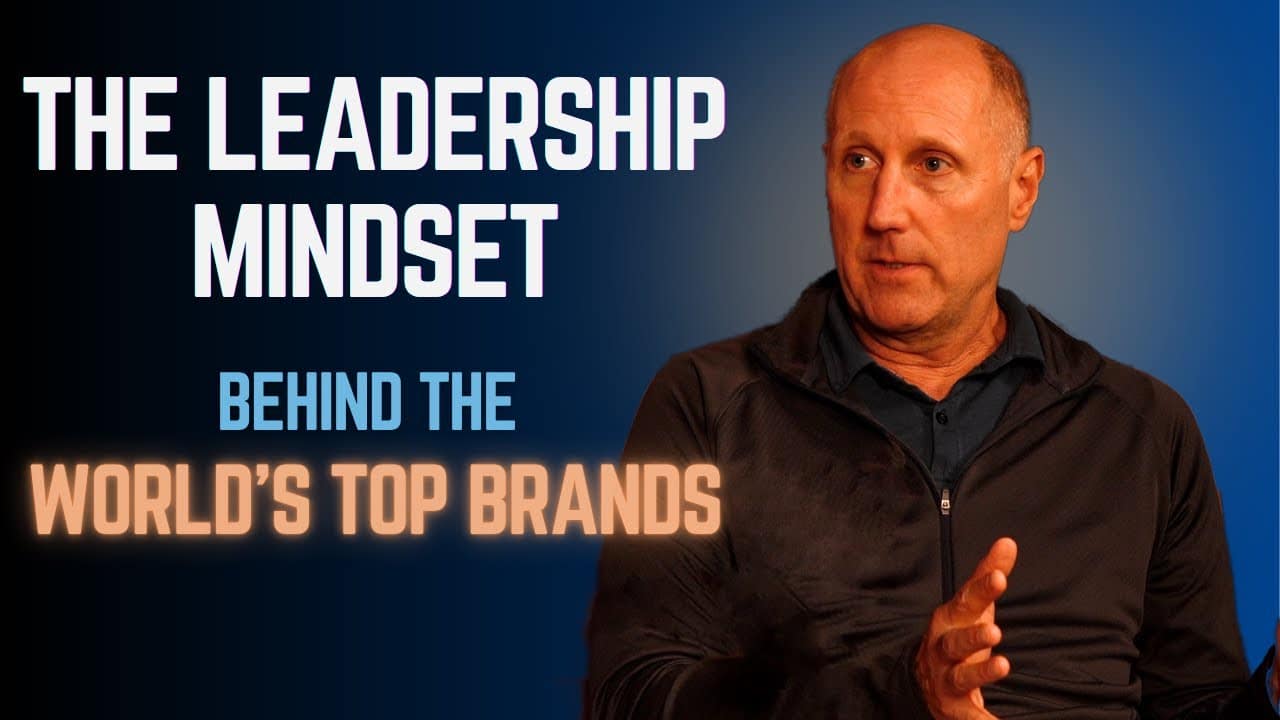
What does it take to lead some of the world’s most recognizable brands? In this episode, Shaun Dyke sits down with John Carmichael, President of Kimberly-Clark North America and former CEO of Nestlé Canada, to explore the mindset behind leadership at the highest level. John shares lessons from three decades leading billion-dollar businesses across Nestlé, and now at Kimberly-Clark. These lessons include how to drive growth, navigate change, and build culture rooted in clarity, courage, and trust. They also discuss how great leaders think, how they make tough calls, and what separates those who manage from those who truly lead. It’s a rare, candid look at leadership inside some of the world’s top brands and the mindset that drives success.
Shaun Dyke
00:00:01.200 – 00:01:49.550
John, incredibly happy to have you with us today.
Just wanted to extend appreciation for the time that you’ve spent flying out here and hanging out as well. You and I have known each other for, gosh, over a decade in various different roles.
John Carmichael
00:01:49.550 – 00:01:50.910
I think it’s pushing closer to two.
Shaun Dyke
00:01:50.910 – 00:02:20.039
Two decades? Yeah, it’s been a bit.
And we’ve got to talk about a lot of leadership connections along the way, a lot of sort of personal approaches that you’ve done and you’ve hit some of the incredible milestones that a lot of people look for.
You’ve led multi billion dollar businesses, incredible transformations, all kinds of really phenomenal things that we’re going to dive into. But before we get into that, how would you introduce yourself beyond the resume? What would you want people to know about John Carmichael?
John Carmichael
00:02:21.239 – 00:03:33.790
That’s sort of an interesting question. I hadn’t thought about that before. You know, I think probably that if I were to say, what’s my brand essence? Right.
Marketer by background, I think I enjoy adventure. I enjoy change and discovery, that kind of thing.
Personal life, private life, public life, professional life.
I think it’s shocking that I’m in a large corporation because my belief as a younger professional was entrepreneurism, and that change was going to be what was going to feed that sense of adventure. Wouldn’t have been articulate about it, but that’s probably what I would have said.
And I would say the resume that I have now is probably just the sum total of a lot of really interesting experiences that kept the learning curve steep and kept me interested and intrigued in a way that it’s sort of the outcome is here I am.
But, you know, even on my private time, as you know, I love to go backpacking and I love to get out in nature, and I love to explore from that perspective. I love to travel because of the sort of curiosity of discovery of a new place.
And I think that’s probably a more interesting way to talk about myself than my resume certainly would be.
Shaun Dyke
00:03:34.510 – 00:03:56.210
I don’t know. You’ve had an incredible resume as well that’s been full of adventure, and so we’ll chase it some a bit.
But you’re headed into a pretty significant adventure right now as well.
Coming off of being CEO and president for Nestle Canada, moving into president of North America for Kimberly Clark, that’s a huge transition and a lot of adventure tied up in that as well. Daunted? Excited?
John Carmichael
00:03:56.210 – 00:04:49.650
Excited.
Yeah. I mean, first of all, you got two incredible organizations, and I know Nestle really, really well.
But some of the things that have made Nestle great is bringing people in from other organizations with different perspectives enabled to sort of collectively create something different over time.
And so what’s neat for me from an adventure perspective is you got this incredible organization at Kimberly Clark, over 150 years of success and all the things that they’ve racked up, and I’m really fascinated to go there and learn about that. What is it about this organization that has done so many incredible and incredibly successful things over a period of time? What drives that?
What culture nurtures that? So that part of it is fascinating to me.
And then coming from a different perspective, I’ll probably have some insights just because I grew up in a different world, as people have with me. So I think the combination of those two things is really exciting. I’m really looking forward to it.
Shaun Dyke
00:04:49.650 – 00:04:51.850
Ultimate adventure, for sure.
John Carmichael
00:04:51.850 – 00:04:53.170
Absolutely. Yeah.
Shaun Dyke
00:04:53.170 – 00:05:01.050
You and I talked a lot about it.It wasn’t an easy transition to pull out of three decades of your work with Nestle.
John Carmichael
00:05:01.050 – 00:05:07.060
No. It’s a family. I mean, three decades, 30 years, you grow up with people. It’s more than half my life.
Shaun Dyke
00:05:07.060 – 00:05:07.620
Yeah.
John Carmichael
00:05:08.180 – 00:05:10.980
And that team means everything to me, as any team does.
Shaun Dyke
00:05:10.980 – 00:05:11.220
Right.
John Carmichael
00:05:11.220 – 00:05:20.539
Any family does. And so I really want to make sure that they’re set up and they’re going to do well. And the reality of not being there to take care of them takes a moment.
Shaun Dyke
00:05:20.539 – 00:05:20.900
Yeah.
John Carmichael
00:05:20.900 – 00:05:22.420
For any leader, I would think.
Shaun Dyke
00:05:22.580 – 00:06:22.690
Yeah. No matter how much you think you’re ready for it, those are hard spaces. Absolutely exciting and hard.
So I know the intentionality you really put into this decision, it was not an easy decision to make, one you’re excited about, but not an easy decision.
And that intentionality is something that, if you’re willing, I want to hit at a little bit, because, you know, we talk a lot about on this forum that the vast majority of people lead and live life by default, not really by design. They tend to allow themselves to sort of jump in the river and let life take them along a course that’s going to take them along it.
They don’t necessarily intentionally plot and plan. That’s never been my experience with you.
Whether it’s the way you interact with people or speak to individuals, business strategies that you’re bringing present, the way you’re leading always seems to have a deep sense of intentionality behind it. How’d that wiring come about? Have you always been that way?
Has that been something that you’ve really had to curate and bring present, or has that been something that’s always been in you?
John Carmichael
00:06:23.070 – 00:06:24.270
Yeah. How deep you want to go?
Shaun Dyke
00:06:25.150 – 00:06:27.150
Man, I got all the time in the world.
John Carmichael
00:06:27.150 – 00:06:57.740
Because, you know, as you think about it, and I think in my own head on that one, I think probably the beginning comes from deep anxiety. Right. Of not wanting to mess something up and needing to put the thought process in to ensure that.
I think so many of us, if we’re really going to be honest with ourselves, that’s what it comes from. It’s sort of the dream state to be naked in front of the class. Right. To a degree, it is such a famous reoccurring dream that people have.
And I think it’s probably. Probably where it started from. And then after a while, it was optimization.
Shaun Dyke
00:06:57.900 – 00:06:58.220
Right.
John Carmichael
00:06:58.220 – 00:07:40.570
I Mean a type A personality probably exists somewhere in my psyche and you know, these interactions are priceless and they only happen once if it’s a small conversation or if it’s a big group.
And how do you make sure you get the most out of it? I think that. So that’s a more productive and maybe constructive way to look at it over time. But that comes with maturity and self confidence and.
But I think that’s probably a large portion of it is this moment is never going to happen again. How do we get the most out of it? And this move is never going to happen again.
So how do I make sure that the collective trajectory that these consecutive moves put me on or us on are the right one?
Shaun Dyke
00:07:40.650 – 00:08:24.560
And it’s funny too, because I think you sort of have this bifurcation of mindset when that uncertainty shows up for some and that insecurity or that anxiety manifests. You have some people that run from it or just tuck away from it and then you get some folks that walk directly at it.
You’ve heard the language we use. We would qualify the difference between being in the arena and in the stands.
Like that’s that choice to take those intentional moments and do something with it.
So you have a leadership philosophy that I was recently exposed to, which is outstanding.
You wrote a line inside of that that I wanted you to chase a little bit because I think it’s incredible line which you said that clarity is kind.
Would you talk to that a little bit?
John Carmichael
00:08:25.360 – 00:10:10.700
Human nature is you beat around the bush. Right. And we sugarcoat things.
And maybe you start from a place by saying how unkind that is. Right. Because everybody wakes up in the morning trying to be their best self.
And the thing I always think about is a leader’s number one responsibility on a one on one basis is to help them get there and not be someone they aren’t or try to improve in that sort of way.
But definitely to be their best self and to not be able to give clarity to them one on one, which is the first maybe scallop you might think of on that one is unkind to a degree.
And therefore the more clarity you can give is the greater kindness in that particular instance because it enables them to have the transparency of how they’re being perceived or an alternative of how they may operate differently, which they can choose to act on or not.
But without that transparency, that authentic sort of feedback loop, they don’t have the benefit of being able to be their best selves potentially for other folks. And then with organizations it’s even more important. Right.
Because I think a lot of things you see, there are people who artificially maybe inflate the organization in a more of a cheerleader stance to say, aren’t we great? When the reality might be something different.
And I think it is so much better to come from a place of authenticity and reality to say, well, this is where we are and we are great on some things and we can be great on others.
But without that straight talk, I don’t think an organization or a person can take a step back, reflect, and then decide how they’re going to show up the next day.
Shaun Dyke
00:10:12.060 – 00:11:04.900
So often I encounter spaces where people want clarity on clarity. So what do they mean by that? They want mapquest directions.
They want this discrete set of directionality that I need to go. And that’s often coming from a fear based that we. The other space around like, oh man, I don’t want to screw this up.
If I get these perfect directions from it, I can execute. But then that level of clarity is exhausting. It’s unrealistic. And you cannot do that from your chair.
On the flip side of that, the movement frequency of clarity, things change, things shift constantly.
How do you strike that balance between creating clarity, but then also creating an expectation of clarity, seeking from people and finding that lane that just seems to fit. Right.
John Carmichael
00:11:06.260 – 00:12:14.060
Yeah. Maybe two thoughts on that. The first one is, is that you are there to help them become their best selves, not your best self.
Right. And so if you’re given MapQuest directions, which by the way, I think does date you, but. But we’ll get back to that later.
If you’re, if you are to give maybe Google Map direction. I think the scenario there is you’re really telling them what’s your best self.
Right. And in that instance, you’re doing a disservice. Right. Because you’re. You’re giving them advice to be somebody they’re not.
And that can be incredibly damaging, especially from a position of authority. And so you’ve Got to do it with the mindset of helping them become their best self. And by doing it, you have to give space.
You can’t give a prescriptive response because it absolutely goes to a very, very specific endpoint. We’re going to stick with your analogy.
The more space you can give them, the more that they can play in that space to figure out what is their reality.
So all you’re doing is you’re giving them the clarity of how you perceive it or how others might perceive it for them to deal with it as they wish to deal with.
Shaun Dyke
00:12:14.780 – 00:12:24.020
Incredibly functional. It’s something that we find moves all the time. So we always say clarity lasts about a nanosecond. Right.
There’s just shifting space on it all the time.
John Carmichael
00:12:24.020 – 00:12:24.420
Yeah.
Shaun Dyke
00:12:24.420 – 00:12:35.700
So we always say, hey, let’s teach you how to read a compass and a topographical map. I like that. Because when the landscape shifts and changes, you can use those base tools to create that clarity as you’re moving forward.
John Carmichael
00:12:35.700 – 00:12:47.330
No question. It’s almost like if you look forward, you know, you sort of a funnel of alternatives out there and you make a decision where you’re going to go.
And at that point there’s a new funnel that arise, and where you came from is almost irrelevant.
Shaun Dyke
00:12:47.330 – 00:12:48.170
It’s immaterial.
John Carmichael
00:12:48.570 – 00:13:28.250
The fact of the matter is you are here and now you’ve got a new set of. And you get to a point where you hope you had some intentionality of that’s where I was trying to get to.
But you probably, as you look back, wouldn’t have taken that path because it’s a series of independent decisions.
I think one thing that is important in intentionality, to use that word you brought up earlier on, is you do need to know what you’re trying to create, who you’re trying to become, what you’re trying to build.
You need an end state in mind to ensure that you have sort of a true north and where you’re going.
That said, the decisions along that will not only surprise you, but the true north of the thing you’re trying to build will change over time as you understand yourself better and you understand the possibilities of the organization.
Shaun Dyke
00:13:29.130 – 00:14:13.160
That’s a fun chase. It implies, which I believe to be true, that somebody has a why behind or a purpose or a reason for their existence or what they’re trying to do.
Whether that’s a professional in a business space or a homemaker, that they have some level of intentionality between where they are today and what they’re wanting to accomplish. Whereas I Think a lot of people don’t. Again, default versus design. So part of if I loop it back to. So I’d ask you this for clarity.
If I loop it back to like your ability to be intentional. Is some of that tied to you knowing those end states and that why behind you do the things you do?
John Carmichael
00:14:13.400 – 00:14:51.680
I think yes. And yeah, I think, I think I do try to have a vision of where I’m headed for myself, for the organization.
But I keep it really flexible because the challenge is if you don’t keep it flexible but you’re not the end see, it’s not going to look like that.
Better, worse, whatever.
But if you don’t have the flexibility in your vision of it, then you can constantly come up short or see failure in the fact that it didn’t manifest exactly as you saw it put. So you have to have the flexibility. But I do believe you need to understand what you’re trying to build.
Otherwise the decisions that you make on your journey to get there are simply independent decisions you’re making in the fly.
Shaun Dyke
00:14:51.680 – 00:16:20.880
Sure. What’s the point that I’m trying to accumulate?
Hey, let’s shift to something that I think is a complicated space these days and people really struggle knowing how to bump into.
You have always been someone that I’ve recognized and admired on being able to be courageous in their leadership. So that means being able to stand up for things that need to be stood up for, being able to push back when things need to be pushed back on.
So we’ll put it in this construct of sort of corporate dogma that exists. And by corporate dogma we mean things like cultural norms, those long held assumptions, the sacred cows like oh, you can’t, you can’t violate this.
The vast majority of every business has these on some way, shape or form. They can be enablers and they can be incredible disablers.
You had said being mindful about corporate legends and dogma and when you need to push back against those versus when you need to admire the legacy that has been.
If you’re a leader out there listening that’s aspiring to lead at the level that you lead, what’s the counsel you would give them on how to really read the winds and knowing when you push back on that corporate dogma as A limiting factor versus when you have to sustain that as an enabling factor.
John Carmichael
00:16:20.880 – 00:21:22.920
So maybe two points. Maybe a heritage story for me personally and then maybe a current situation that I see the world in now.
So the heritage story was I was given this incredible opportunity from a CEO who is very, very future oriented and wanted to understand why we couldn’t be more innovative. And so I was doing marketing development at the time, training, capacity, capability building, this kind of thing.
And so what a cool journey for a guy who’s wired like me to go after with, you know, sort of curiosity. And, and, and I do like to innovate.
And, and so I spent a serious, a pretty significant period of time just kind of looking around, talking to people, interviewing, doing some studying to myself. I went to, did some coursework and I, what was interesting was, and this was his, his, his briefing of it.
He says no one’s telling these people they can’t do this and yet nobody’s doing it. So what, so what’s the thing there? And we kind of came up with this idea of the invisible no.
And the invisible no is that no one’s really ever said it or they said it in indirect ways or they’ve seen it said to somebody else.
And so what people do is they create these boundaries and barriers that are sort of invisible and self generated that aren’t necessarily really there. And I think it’s human nature to a large degree.
But in big organizations where people are loss adverse and concerned and focused on what they, what they need to do to get up based upon the conventions and cultures of that organization, it’s even more pronounced and it’s especially pronounced in leaders who tend to be adept at reading the organization and reading where the invisible nos are. And so the idea was how do you decide, how do you work against the invisible nose?
And so it’s a little different than the way you describe dogma, but I think that’s the origin story for me is, is how do you develop a culture that breaks those barriers or maybe prevents them from happening in the first place. And that’s a four day conversation over several glasses of wine right today. I think what I find is there’s that famous quote, what is it?
The world’s never changes fast and it’s never going to change as slow again. Something to that degree. And that’s become somewhat trite because you know, it said so often.
But, but I think at some point we hit an inflection point which says that, that the the degree of consistency in, in driving success versus the degree of sort of flexibility in driving success has shifted. And, and I think of it like athletics to a certain degree.
And if you think about great athletes like, like let’s, you know, talk about those that maybe are in the Olympics, the way they succeeded in most of, the, most of the disciplines out there are to be able to repeat the same thing with slightly more precision each time, either faster or better or brighter. And I think that’s the way large corporations succeeded. Right.
It was a game of, of seconds, of pennies, of, of, of process design that made it just incrementally better over decades and some, in some instances, centuries. And so these, these systems developed on scale that were able to be amazingly effective and efficient. And that’s how you won as a big company.
And in a world of relative stability, it still is. Right? The advantage of scale in process, in dogma in those kinds of things was really efficient and it was positive.
The storied, centuries old organizations that we know today, that’s how they got here. And so what we’re all guilty of is projecting that the future success will come in the same way the past has come.
And I believe we’ve passed that inflection point.
In a world of pandemics, in a world of inflation, the worst in 70 years, in the world of tariffs, in the world of you pick the next thing, but, you know, now there will be a next thing. It is about your adaptability and your ability to go.
And so if you switch from the runner who wants to shave off a half second or the swimmer that decides to shave their legs because they know it’s going to be.
And so it’s all about that repetition of sort of muscle memory as something very specific, I think, of surfers, right, which is a very different thing. So maybe it’s a Southern California thing and you can relate a little bit for this.
Every wave’s different. And it’s not about the precision of doing the exact same thing exactly the same way, but a second better.
It’s about reading the wave, understanding your environment, and doing the thing that’s situationally appropriate to ride the current wave that you’re on. And again, you need that vision of where you’re headed. Otherwise it’s just chaos and a bunch of individual decisions.
And it isn’t that the skill set is still incredibly valuable, like the balance and the ability to read the wave and all the things required to be an outstanding surfer are still really, really important. And it is a sport with Specializations and capability building.
But the thing that you add into it is the ability to read the wave and respond to something that is unique every single time. So it’s a less like a sprinter and more like a surfer. So that may not answer your question.
Shaun Dyke
00:21:22.920 – 00:23:01.920
Imagine this.
So you know, you’re a new surfer, you’re bringing out your board for the first time, second time, third time, you’re getting it and you’ve got those old timers that have been in the water for a long time and they have an approach and they know. And then all of a sudden you come in and you’re trying to push on that standard way things are done. You’re gonna get reactance.
So I think sometimes what we hear or we see happen is pretty senior leaders trying to invoke a willingness for the people that they’re leading to challenge dogma, challenge that status quo and push on it. But that invisible no can be really strong, especially if they push.
And that surfer that’s been in the water and been surfing that wave for 30 years says Ah, that’s not what we do here. That tends to get really shut down.
So what’s the advice you give to those folks that are new to surfing or they’re coming into an organization or that they’re more junior in it and they see less effective, less efficient ways that things are happening and they really want to push on it. But you know, they’re six tiers down from the CEO chair and they try to knock on it and they just get shut down or that, that invisible.
While oftentimes I agree is a function of self limiting beliefs, we create those. But at times those are genuine things that happen. Somebody pushes and they get a shutdown.
So what’s the counsel that you give to somebody that’s really trying to push back on that dogma or try to evolve it to a new place, but they just keep getting hit with either that perceived or that real. No.
John Carmichael
00:23:02.000 – 00:25:02.990
Yeah. Yes. There’s two different perspectives on. Right.
So one is the perspective of the leader who’s trying to develop a culture that maybe protects against the invisible. No. Or maybe enables a situation where it doesn’t get created in the first place.
The second one is the individual who’s trying to find their way in a corporation and let’s say has a great idea or a thought process that’s different and how do they approach it? And you’re asking about the latter is what I understand you’re asking about there.
So in the latter situation, I think the question is how do you navigate.
I mean that is probably the word I would use because you know, they often say big organizations are risk adverse and they are, and they can be, but I think more, more appropriately, they’re loss adverse. They are protecting something that has great value that they don’t want to put at risk.
And if you think about it that way, then, then I think if you’ve got a good idea or a disruptive idea or a thought, then the question is if you want to navigate that through the organization, what are the, what is the way to risk mitigated in such a way that those in power to, to give you that authority can allow it to go through? Sometimes it’s, you know, it’s, it’s a massive investment. Right.
And, and the question is, can you chunk it out and find a way to show success over time and earn the, the second and third and fourth and fifth pieces of investment would be a good example of it. Does it put the organization at risk? If so, how do you risk mitigate that?
What are the things that you’re doing that might make somebody or the corporate we of the organization nervous that you can find a way to risk mitigate it or chunk it out in pieces and parts that enables you to allow yourself to continue to progress?
And I think if you find there’s a good idea, you’ve got a good vision and everybody agrees it adds inherent value and you’ve got a way to risk mitigated in such a way that no one’s betting the farm, as it were, then unless there’s a better idea that somebody wants to invest in and you gotta be open to that. Then I think a lot of good leaders are going to let you go there.
Shaun Dyke
00:25:03.150 – 00:25:39.460
And that means you got to have the ability to know how to influence toward an outcome you’re looking for. So if I’ve got something that I want to sort of challenge, if we use that construct of some sort of version of a corporate dogma.
Yeah, I know we’ve done it this way, but what if we do this?
I think a lot of times what we experience is we, we can experience individuals that are, they’re frustrated by the current state and the approach set is almost to just come in to be angry about it and we need to do Something differently versus recognizing that. Look, there’s a big if, then table here.
If this is the outcome that I want, then this is the approach that I need to take to move it to a new place which involves skillful influence in my capability set. Fair.
John Carmichael
00:25:39.860 – 00:26:11.770
It does.
But, you know, I think, you know, I always say that the best way for you to develop is to figure out what’s the mindset and the decision set of the person and group that’s the next level up and get yourself in that and start thinking in their decision. Or what better way than to say, why would this person say no? What is the risk associated? Or the, the.
The threat to resources or, or the priority of resources that would cause them to say no to this? And how do I get myself in that mindset?
There is probably no better development for the next level of your career than to put yourself in there and find a way to influence them in that way.
Shaun Dyke
00:26:11.770 – 00:26:25.490
If somebody’s listening and they say, gosh, I’m in a spot where I really want to challenge an existing legacy thought process or an approach that this organization uses, what’s the first step I take?
John Carmichael
00:26:27.890 – 00:26:58.160
Probably understand. Seek to understand. Always.
I say to seek to understand why you think that exists in the first place and what purpose does it have for the organization and then work with it from there.
I think, you know, oftentimes, because I’m a bit of a rebel. I was the family rebel, some might argue I still am. Shocking. I survived in a big corporation, to be completely honest with you.
But I think the first thing is to fight, right? Is to disagree, to fight, to push rather than seek to understand.
And I think if you take that step first almost in everything, it puts you in a better spot.
Shaun Dyke
00:27:00.480 – 00:27:02.800
Not done often, no.
John Carmichael
00:27:03.040 – 00:27:15.130
All of us, right. I think we’re all guilty of not doing it enough.
I think if you look at the discourse going on in the country right now, I’d say regardless of what your point of view is, there’s not enough of it going on. So what better time to set an example?
Shaun Dyke
00:27:15.450 – 00:28:20.920
Last piece I’ll chase for you is a big transition for you.
So three decades with a family inside of Nestle and moving into a new space where the scale of impact you’re able to have is incredibly elevated and has a potential element of dauntingness to it, yet also an element of incredible felt responsibility around it that can get weighty and people can drop into, I think, almost a anxious stress state around it. And I know part of your philosophy is figuring out really, how do you maintain joy in the journey as you go through all of this?
So as you enter into that transition, where’s your head and thoughts around how you maintain joy around this?
I mean, it’s an adventure, and I know you’ll be excited about that in general, but at the same time, I’m certain that it’s going to come with some seriously weighty nights that you’ll be pondering those dark nights of the soul as you’re working through spaces.
John Carmichael
00:28:24.120 – 00:32:07.790
I’ll give you two thoughts, one of which I imagine you’re expecting, and the other one, I bet you’re not.
And the first one is.
We often get caught up in the grind. And I’m a backpacker, right? It’s what I love to do. I’ve done it for years and decades and decades, and it’s a big family thing.
And I’ve got a group that does it every. Every single year for 23 years. And.
And so the analogy I will use is on that, you know, you’re looking up at the mountain you need to climb, and you look up at it, and it’s daunting and it’s way up there, and you’re spending your energy figuring out your path that you’re going to get there and figuring out how you’re going to get yourself and your big, heavy pack up to the next altitude.
And I found that what’s really, really important, and this is an analogy in life, is to turn around and look at how far you’ve climbed and enjoy the view and stop and appreciate the effort that it took you to get there and the beauty of what has been accomplished and do it as a team, too, because generally you’re doing it with other people, and we don’t do that enough. And I’m as guilty of it as anyone, but I find whenever I’m getting super duper frustrated, that is my trigger to say, how far have we come up? Right?
And look at the altitude and enjoy the climb. So I think that’s one really important piece. And I do do it on a regular basis. It is part of my discipline.
I never do it enough, and I never do it for my team enough. But I try to do that as much as I can. Capture the small wins, too, of course, is of the same theory and concept.
The other one is sort of know your purpose, right? Which is I which I think is helpful. I always say what would. What do you want people? What do you want?
What do you want on your gravestone at the end of the day? It’s a question I’ll come back to you on a minute. So you’re lucky I give you some time to thought.
Mine came from the best job I’ve ever had which was a camp counselor when I was 19 years old. 20, 21, 22 frankly I’d still in many ways camp counselor I suppose my team would say.
But I had, I had a cat, I had a camper who was afraid of horses but really wanted to ride the horse. And the kid was six, right. So pretty darn young giant animal. It’s intimidating under any circumstances when you’re six year old.
And it’s. It scared him. And, and so we worked on it over the course of the summer. Right. I think, I think I had him for two sessions.
So I did have him for an extended period of time because I couldn’t get him near at the beginning. But it was clear he really wanted to do it because he always gravitated to do that. He’d sign up for horses but he’d never go up there.
And so little by little we got him closer and closer to the horse. The person who ran the, the horsing group was, was with me on that and, and eventually the. We got him on the horse but we wouldn’t move.
And then over time in any event, to make a long story short, at the end of the summer we had this kid riding and his parents came to pick him up very aware that he was completely frightened of probably all large mammals, but certainly horses. And the look on this face of this kid when he rode the horse up degree his parents. Because we’d worked it right.
We worked it that he was going to ride the horse up to me it was something that to this day breaks me up.
But that ability to try and get a team to be their best selves individually and collectively and to do something they couldn’t imagine they could have done. That’s what it comes from. That’s what’s great. Yeah.
And, and if you’re doing that, whatever it is for you, that’s what it is for me doesn’t matter to mean it needs to be that for you. But if whatever it is for you, if you are doing that, there is joy. It doesn’t always feel like joyful, but there is joy.
And again if you’re looking the Vision of what do I want to accomplish? As long as you hold that in your heart and you go after it, then. Then you’re doing the right thing day by day to make that happen.
And that thing that you want on your gravestone that you want to be known for at the end of the day, day you’re going to be known for.
Shaun Dyke
00:32:08.270 – 00:32:30.190
Love it. So you want to be known. Yeah, I was waiting for that.
So this one is something that I’ve thought about a long time and it’s actually one of the core drivers of my entire career arc. And it comes from.
It’s a quote that we’ve talked about actually on this show is it’s a Thoreau quote that the masses of men lead lives of quiet desperation.
John Carmichael
00:32:30.910 – 00:32:31.390
Wow.
Shaun Dyke
00:32:32.180 – 00:33:21.690
The so many people sit silently in a state of longing for something more than they are being. Whether that’s a leader, whether that’s a parent, whether that’s a friend. They’re sitting in the stands.
They want a different life and they will live it vicariously through a movie they watch or a book that they read and they’ll wish and they want. And that frankly just pisses me off. I don’t want them to do it.
So I have constantly and consistently tried to live in this space that says how do I help people first recognize what they want to do and are able to do and then realize it. Get out of your own way. The amount of self limiting beliefs that we put on ourselves that push us into those stands where we just don’t want to do.
Man, I don’t want that. So my hope is that on my, you know, my headstone it says that I disrupted that.
John Carmichael
00:33:21.770 – 00:33:22.530
That’s really cool.
Shaun Dyke
00:33:22.530 – 00:33:23.210
Yeah, it’s fun.
John Carmichael
00:33:23.370 – 00:33:25.610
That is amazing aspiration if you can achieve that.
Shaun Dyke
00:33:25.690 – 00:33:44.890
Man, I don’t know yet. Towards your point before, we always describe it as planting oak tree seeds. You just probably will never see them grow fully. Yeah.
But you can plan them along the way. That’s true. Genuine appreciation for you hanging out with us today. I’m incredibly excited to see what you do with Kimberly Clark.
That leadership team is. They’re fortunate to have you. So thank you. Attention.
John Carmichael
00:33:44.890 – 00:33:45.930
I’m fortunate to have them.
Shaun Dyke
00:33:45.930 – 00:33:46.210
Yeah.
John Carmichael
00:33:46.210 – 00:33:49.170
I mean that’s the fun. And I can’t wait to see what makes them tick.
Shaun Dyke
00:33:49.170 – 00:33:56.970
Yeah. I think it’s going to be an incredible transition for you. So excited. Thanks a ton. Appreciate it. And until next time, always a pleasure.
Thank you, sir.