

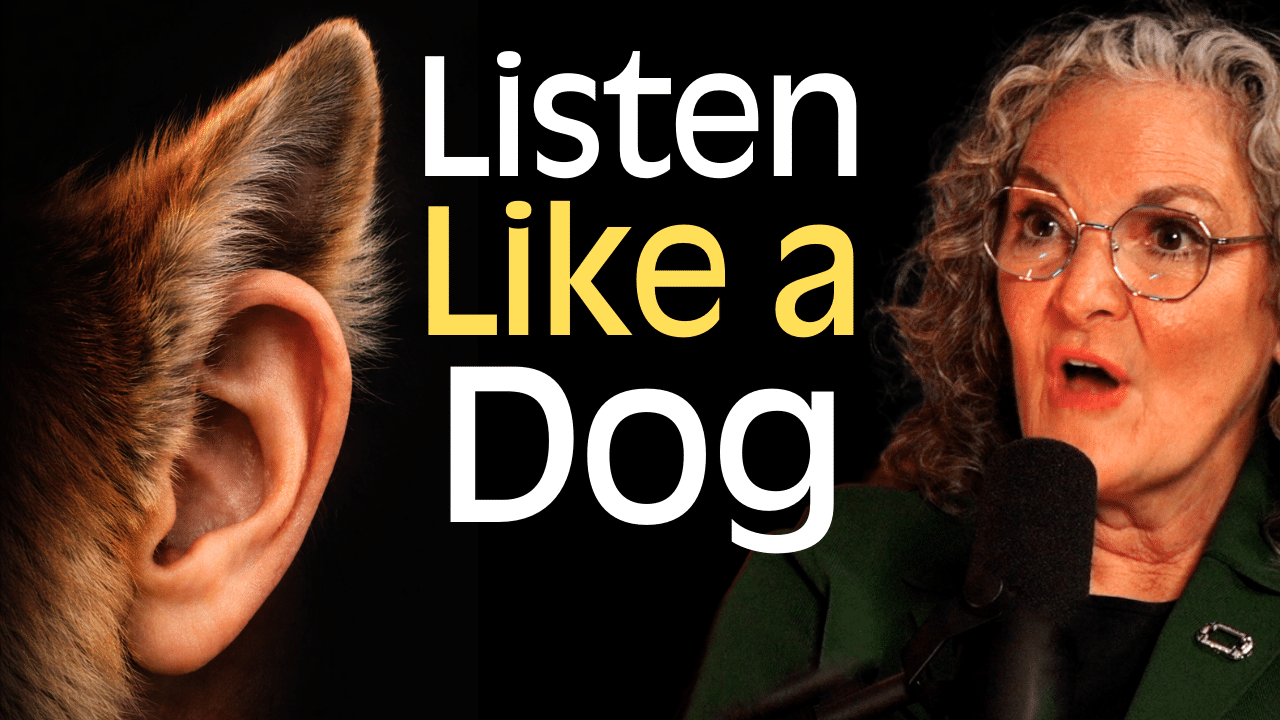
Most people can only name 2-3 people in their entire life who have truly listened to them. Not partially. Not while checking their phone. Truly listened.
In this episode, DoorTwo Principal Anna Baldwin unpacks why listening is the most underdeveloped leadership skill, and why your dog might be better at it than you are.
Anna draws on 20+ years of leadership experience, from leading Verizon Wireless teams to the top 1% nationally to serving as COO at two companies, to share a framework she’s been using with clients for years.
You’ll hear about what dogs do that most leaders don’t, the difference between “yes, but” and “yes, and” cultures, the Gallup finding that 10 minutes of authentic engagement per week can transform your team, and why 2025 saw the lowest employee engagement scores in years at just 31%.
If you’ve ever walked out of a conversation wondering whether the other person heard a single word you said, this one’s for you.
▶ Watch the full In the Arena series: In The Arena with DoorTwo Podcast
📬 Get our weekly leadership newsletter: DoorTwo Leadership Newsletter
[00:00] Shaun Dyke: [upbeat music] Welcome to In the Arena. My name is Shaun Dyke, managing partner with DoorTwo. Today, I am joined by the one and only Anna Baldwin.
[00:18] Anna Baldwin: Hello. [laughs]
[00:19] Shaun Dyke: [laughs] Hi, Anna. Look, for those listening and for those watching, before we jump too far into it, contextualize who is Anna Baldwin.
[00:30] Anna Baldwin: Well, I am fortunate enough to be celebrating seven years at DoorTwo. Friend of the firm for over 20.
[00:37] Shaun Dyke: That’s right. That’s right. Long time.
[00:39] Anna Baldwin: So long time. Long time. I live in North Carolina with my husband Ed.
[00:43] Shaun Dyke: In the woods.
[00:44] Anna Baldwin: In the woods, in the mountains.
[00:45] Shaun Dyke: In the mountains.
[00:45] Anna Baldwin: It’s kind of like a tree t- little bit of a tree house, yeah. Loving, golf, hiking, lakes, paddle boarding, outdoor. Anything outdoors, I’m in.
[00:55] Shaun Dyke: Love.
[00:55] Anna Baldwin: Yeah, so really love that. We have two, dogs, and, my daughter Brianna, my ad- she lives in Maryland, and we get a chance to visit quite regularly. I got here in a, in a fun way. Friend of the firm. Well, I was a client-at one point in time. Had an opportunity to go through a number of our programs. changed my life. Really and truly, changed my life. And, had this wonderful opportunity to be able to practice it over the years. So, I worked for Verizon for six years, inside retail sales and B2B sales. I’ve worked in the restaurant industry for many years. my last two roles, chief operating officers, different companies. And being able to take the things that I learned at DoorTwo and being able to apply them and now being able to, coach and share real-life stories of either having done it in my practice or helping others to do-the things that we get to teach is pretty amazing. Living the dream.
[01:59] Shaun Dyke: It is.
[01:59] Anna Baldwin: Living the dream.
[01:59] Shaun Dyke: And I love the way you positioned that we get to, right? It is pretty incredible. it’s fortunate that we do get to do these things. There’s a host of things that we could talk about. Limitless supply-of things we can talk about. And when we talked about you, chatting with something that you’re passionate about, you chose a topic. The topic is?
[02:17] Anna Baldwin: Listening.
[02:18] Shaun Dyke: This can go a lot of different dialogues and directions, and then you linked it into something that I love.
[02:22] Anna Baldwin: [laughs]
[02:22] Shaun Dyke: Because I know you have a deep passion for your dogs.
[02:25] Anna Baldwin: I do. [laughs]
[02:26] Shaun Dyke: You do. They’re amazing beings.
[02:30] Anna Baldwin: yes.
[02:31] Shaun Dyke: and you teed it up with me on, “I wanna talk about how to listen like a dog.” I have to admit, I did not know what the hell that meant.
[02:40] Anna Baldwin: I know. I like that.
[02:42] Shaun Dyke: It’s fun. So let’s just begin inside of that space on, like, how to listen like a dog. But why do we care? Why does it matter if we know how to listen effectively? What’s the big damn deal?
[03:00] Anna Baldwin: You want someone you care about to be heard, feel seen, trusted, valued, respected, safe? Listen. In business, if you really wanna understand the root cause of what’s happening in your business and what needs to be fixed-
[03:19] Shaun Dyke: Listen
[03:19] Anna Baldwin: listen. You wanna be present. You want to, you want to increase productivity, listen. You wanna solve problems that have been existed for years upon years and you just haven’t figured it out, listen. And ask great questions.
[03:36] Shaun Dyke: And the good part is when we go through our formal education, like high school and college, they teach us this skill, right? We, we learn how to listen. Not even remotely. It, it is a completely underdeveloped skill. And in the world in which we would chat, we would talk about communication as the fundamental way in which information and/or knowledge is conveyed. A spoken or a verbal dialogue that happens between people. And in those spaces, we talk about it as there’s, there’s a sender of information and there is a receiver of information, and those roles bounce back and forth. Speaking is one part. Listening is the other part. And I think you and I would both say that though they may not think it, most people could really enhance their capability around listening.
[04:30] Anna Baldwin: Mm. Yeah. Sean, you know, one of the things I ask oftentimes in a program, when we’re teaching a program, our Leadership Essentials or our Motivating Transformational Leadership, those two programs are where we’ll actually teach. And when we look at listening, and I’ll ask how many people… Like, go through your life. Just take a moment. I’d love to, for you to do this at home as well, and really think about growing up, education, family, friends, bosses, all the way to whatever age you are today. How many people in your life have authentically listened to you? They didn’t want anything from you. They didn’t have an ulterior motive. They just wanted to be present for you and whatever it is you needed or wanted to express. And what I have found over time, year after year, program after program, the majority of people will say two to three people-
[05:40] Shaun Dyke: Two to three people
[05:41] Anna Baldwin: in their life that they can look to.
[05:45] Shaun Dyke: It kind of makes me a little sad, in all honesty. the… I think the vast majority of the… And look, and we get to do this as our practice. we are rendered relatively useless, ineffective, if we don’t listen-to what is being said. In fact, we say all the time, and, it’s been said on this show-That people are walking billboards. They advertise-so much about them, but if we’re unwilling or unable to listen to what they are saying, then we’re just gonna miss it. It’s gonna move right past us. And to your point, lots of the world do not feel listened to often. What has made listening such a scarce skill?
[06:38] Anna Baldwin: You said it earlier, a little bit, of we don’t, we don’t get taught to listen. And oftentimes, it’s the loudest child in the family.
[06:52] Shaun Dyke: [laughs]
[06:52] Anna Baldwin: The, in elementary school, the outgoing, let me raise my hand, let me share what’s going on. new in the workforce, they’re the ones that are, you know, regularly saying things. I mean, w- I think we all know people in our lives that are really good at talking and presenting themselves, and there’s-
[07:14] Shaun Dyke: Are you talking about me right now, Anna?
[07:15] Anna Baldwin: Well, I was-
[07:15] Shaun Dyke: Potentially.
[07:15] Anna Baldwin: Well, I was about to say, not a lot of depth underneath.
[07:19] Shaun Dyke: [laughs]
[07:19] Anna Baldwin: So, [laughs] so no. [laughs] No, I wasn’t.
[07:23] Shaun Dyke: [laughs]
[07:23] Anna Baldwin: You walked right into that one there, Sean.
[07:25] Shaun Dyke: I did. If I would’ve just listened-
[07:27] Anna Baldwin: [laughs]
[07:27] Shaun Dyke: for like two seconds longer, I wouldn’t have thrown myself under the bus on that one.
[07:31] Anna Baldwin: You would not.
[07:31] Shaun Dyke: Yeah, well done, Sean. Well done.
[07:32] Anna Baldwin: That is not a bus-you wanna be under.
[07:34] Shaun Dyke: No. No, no. I felt that one. Yeah, I do think we reward talking more than we reward listening. The system-
[07:40] Anna Baldwin: Mm-hmm. Yep
[07:40] Shaun Dyke: can collectively reward talking more. And, I think people, authentically believe they have things to say. And they would like to be heard. And so they speak often. Often unconscious of, or maybe even uncaring about, whether or not it’s being listened to. okay. So let’s, let’s… ‘Cause I think this was a provocative way in which you positioned this for me, and so now I’m curious. Listening like a dog. My immediate listening like a dog is just I have to tilt my head back and forth when I’m talking to you or when I’m listening.
[08:16] Anna Baldwin: Well.
[08:16] Shaun Dyke: Shake my tail.
[08:18] Anna Baldwin: [laughs]
[08:18] Shaun Dyke: So talk to me about this concept of the power of listening, being illustrated through our four-legged furry friend.
[08:27] Anna Baldwin: Yeah. I’m gonna walk through them.
[08:29] Shaun Dyke: Okay.
[08:29] Anna Baldwin: And there are a couple that I’d love to go back to, I’m sure-after we get through it. But okay. So let’s just think about it for a moment.
[08:35] Shaun Dyke: Okay.
[08:35] Anna Baldwin: You’re with your dog, okay? Like I said, loving my dogs.
[08:39] Shaun Dyke: I got a, yep, I got a good one. She’s a good one.
[08:40] Anna Baldwin: Dogs don’t interrupt us.
[08:43] Shaun Dyke: They don’t interrupt us.
[08:44] Anna Baldwin: Right. Dogs allow space for us. So when we talk, they allow space. They don’t jump right in with whatever that they wanna share. So they allow us to be able to reflect and then continue to talk. Our dogs know that the most important thing we say is at the end. There’s probably a lot of noise. We’re just getting out the distress. We’re getting out whatever’s in our head, and then we get to the meat of what we really wanna talk about. Dogs don’t build off our story, right? They’re, they… It’s not like ping pong, right? The dog’s just like, “Oh, my gosh. Sean, did you know what? I, w- we just made vacation plans.” And then Sean, what are you gonna say, right? Right? W- and then just-
[09:35] Shaun Dyke: Oh, oh, yeah, I did too. I just came off a vacation, blah, blah, blah.
[09:38] Anna Baldwin: Yeah. And it, and it builds. It builds. It builds, right? And it’s not, it’s not… it’s coming from a place of excitement-and desire to connect, but our dogs don’t build off of it. Our dogs actually allow us to say the sto- share the story we want to share, not building off of it through excitement. Gosh, they’re really good at whole body listening. We-
[10:00] Shaun Dyke: Whole body listening.
[10:01] Anna Baldwin: Yeah. Right? At the firm, right, we talk about whole human coaching. Right? Well, our dogs pay attention to our tone, our posture-
[10:12] Shaun Dyke: [laughs]
[10:12] Anna Baldwin: our facial expressions. My goodness, when we change our shoes from slippers to shoes, okay. Right?
[10:18] Shaun Dyke: They know.
[10:18] Anna Baldwin: they know when we’re happy. They’ll know when we’re sad. They know when we’re angry, and they respond accordingly to that. Right? They, they react, and they’re, they’re present. they’re not distracted. They don’t multitask, right? They’re 100% there. Our dogs are curious, not judgmental. So my invitation is to learn to listen like a dog.
[10:45] Shaun Dyke: Okay, so I wanna hit a few of these again, and then we have to chase them. so let’s see. Dogs don’t interrupt. we have a colleague, Tom Shank. amazing human. He speaks with intention. which then, warrants listening with intention. Still today, and definitely for the first five years that I knew the guy, I would interrupt constantly when he was talking. partly because I’m a Pomeranian, and partly because-
[11:18] Anna Baldwin: [laughs]
[11:19] Shaun Dyke: he would speak with such a slow and intentioned space, I actually often thought he was done talking. He wasn’t. He was letting it settle, and I would interrupt. he would gracefully guide me in that one always. But it wasn’t coming from a place of malice. It was often excitement. So what do you say to the person that they say, “Well, I’m just trying to add. I’m just trying to be complimentary to it. Does it hurt if I interrupt?”
[11:47] Anna Baldwin: Is it about you, or is it about the other person?
[11:49] Shaun Dyke: Nice. Well said.
[11:51] Anna Baldwin: You know, I’ve been really working on listening over the last five years, and I have a similar story to your share about Tom. And Tom is definitely on my list of one of the best listeners in my life. Without a doubt. but my husbandEd, years ago, used to say, “You don’t listen,” every now and then. Like, “You don’t listen. You never listen to me. You never listen to me.” And it would happen, I mean, a few times a year. It wasn’t like it was every day. But every time he said that, it really hurt. Because I’m like, “My gosh, if one of the people in my life that I care about more than anyone doesn’t feel like I’m listening, then something’s wrong.”
[12:38] Shaun Dyke: What’s happening? Right.
[12:38] Anna Baldwin: Like, what’s happening? Well, not exactly proud of this, but I decided to prove him wrong one day. [laughs]
[12:45] Shaun Dyke: [laughs] Wait. Wait. You, having a competitive streak in you. Well, that’s… No, no, no.
[12:51] Anna Baldwin: Little bit. And so I was like, “Okay. So fine.” What… So, we would be having a conversation. He was quiet, didn’t respond. I’m ready to jump back in. So I decided to just say, “Okay. Count to 10.” And but what I realized was 95% of the time, Sean, he had something else to say.
[13:15] Shaun Dyke: You’d get to three or four, and there’d be an add.
[13:17] Anna Baldwin: Yeah. Sometimes it was eight. But there would be an add, and it was very rare that he didn’t have something to add, and that was a wake-up call for me. And so I started to do it regularly with him. Still to this day, when I’m feeling the, you know, the, like, that excitement or that desire to jump in, I’m like, “Wait. Just count. Just wait. Give some space, and then feel free to join if there’s, if, you know, there’s nothing else to be said.” But I use it in all kinds of situations now, and it allows… One, it allows the brain to catch up for the other person. It allows us to be more reflective. It allows us not to have to be so on the edge of our seat that when somebody breathes, we have to jump in because we know that there will be space, and the other person at the other end of this conversation is going to allow me to express what I need to say. And that, I think, is a gift that we can give to others.
[14:21] Shaun Dyke: You know WAIT is an acronym. Stands for what?
[14:26] Anna Baldwin: Why am I talking?
[14:28] Shaun Dyke: Yeah. [laughs] 100%. We teach this often. that if you find yourself in that spot where you’re, speaking unnecessarily, it’s that pause on why do we do that. You said you’ve been working on listening for five years. How did you… Obviously Ed holding up a mirror-helped create awareness for you, but then what?
[14:49] Anna Baldwin: What I learned was… And, and I find that leaders oftentimes will say this, and they’ll say, “Well, I already know what they’re going to say anyway.” “And so they’re just going… Let’s just cut to the chase. I’m busy. I know what they’re going to say, and let me just move on.” and what I have found, that I’m wrong every time, I do not know what someone else is going to say.
[15:13] Shaun Dyke: [laughs]
[15:14] Anna Baldwin: I don’t know what is motivating them or what’s driving them or why they’re concerned or happy or excited unless I ask. And that allowing somebody that space is important. I mean, Sean, I’ve had… I had… I was coaching some… I had actually a client of mine ask me to coach his friend and help a friend out. And we had a conversation, and he started to cry. And I said, “Are you okay?” And he said, “I don’t remember the last time someone actually listened to me.”
[15:51] Shaun Dyke: Yeah. Yeah. This is not uncommon, right? This-
[15:53] Anna Baldwin: No, it’s not.
[15:55] Shaun Dyke: So I wanna jump back to one of them, come back to this one. There’s also something very different about, I know what they’re going to say. That’s not the goal. The goal is them being experienc- experiencing being heard. So it doesn’t matter in that scenario. If the primary goal is for you to know what they’re gonna say, okay, but oftentimes the primary goal in listening is for that individual to be heard. That is different. So change the script in your head space around really what the purpose of that listening space is.
[16:34] Anna Baldwin: What I w-what I would also add to that is when somebody shares that, allow them the space, right, to communicate whatever it is that they were about to say. But don’t follow it with a comment. Follow it up with another question. at work, when an employee brings an idea, and, you know, oftentimes, you know, doing a good job of listening can actually reduce conformity, right? Because-
[17:02] Shaun Dyke: Say that again. No
[17:03] Anna Baldwin: doing a good job at listening can help to reduce conformity.
[17:07] Shaun Dyke: And conformity is what?
[17:09] Anna Baldwin: Oh, things that are getting in the way, of us being able to do our jobs, and red tape, and things that slow us down.
[17:17] Shaun Dyke: The construct of in an organization system or-in a home system as well, really anywhere, when there is a, an experience of, “I have to do these things because I have to do these things,” perceived as not adding value, limitations to what I’m doing, that’s conformity. And so in our lexicon and the work behind this, conformity equals no good. We don’t want conformity.
[17:44] Anna Baldwin: Don’t want conformity.
[17:45] Shaun Dyke: So your assertion is that, which I would support it as well, fully, is that when we increase listening, we reduce conformity. How?
[17:53] Anna Baldwin: Mm-hmm. Well, someone brings something to you that’s getting in the way, and instead of as a leader assuming we know why they’re doing it or they’re just, “Yeah, we know this is wrong. We can’t do something about it,” ask the question, “What would you like to see done about this? Do you have any ideas of how we could improve this? Do you wanna be a part of this solution?”Like ask a few questions that take that problem or that concern and do something about it. But that doesn’t mean it all goes onto your shoulders as a leader. That person coming to you has ideas of… They would not be bringing it to you unless they had an idea of wanting to make it better.
[18:40] Shaun Dyke: Here’s what I often say. let’s take that same thing. So you’re my boss, and we go through that scenario, and you don’t effectively listen to me. But let’s say your boss comes in to chat with you. Weirdly, I tend to find your ability to listen goes up. So in those cases, is that a function of not having the skill or not demonstrating the skill?
[19:07] Anna Baldwin: Definitely not demonstrating the skill.
[19:10] Shaun Dyke: I oftentimes wonder in this space of listening, if, you know, you, somebody… Someone feels or believes that they have an interest in listening, that it’s going to benefit them to listen, that there’s value from them listening, that they’re more inclined to listen like a dog, to be patient, to not interrupt, to fully listen to what is being said. But if they perceive that the exchange, the value for them in it is lower, their listening quotient, their willingness to listen tends to go down. Yeah, and it’s just an… it’s a, it’s a, it’s a provocation, not a statement of fact.
[19:52] Anna Baldwin: I’d say it’s a mindset.
[19:54] Shaun Dyke: Say more.
[19:55] Anna Baldwin: If listening is important to you… actually, forget about listening. You can take that off the table altogether.
[20:02] Shaun Dyke: Yeah. I like this.
[20:03] Anna Baldwin: If another human that’s sitting across from you-or in your orbit in any way, shape, or form is important to you, important, then listen.
[20:17] Shaun Dyke: Yeah. We say every interaction-is either relationship building or relationship separating.
[20:25] Anna Baldwin: Yeah. It’s my favorite.
[20:26] Shaun Dyke: How you demin-… It’s phenomenal. L- I’m gonna state it again because I think that’s one of those things to listen to l- as we speak about listening. Like rewind this one, hit that back button like a couple times to hear this one again, and then take stock. Every interaction we have with another person is either relationship building or relationship separating, and at what frequency do we take stock of how we are doing that? And I think we would both assert that one of the ways, one of the most effective ways to enhance that relationship, to build that relationship, to esteem that individual, is to truly and authentically listen. I don’t know that anybody would disagree with that. The interesting part for me in it is if no one would fundamentally disagree with that truth, and yet in your self-assessments and your observation of asking rooms of people, then why do so few people listen? Ego. Yeah.
[21:33] Anna Baldwin: Distress.
[21:35] Shaun Dyke: S-
[21:35] Anna Baldwin: Having to be the per- the voice in the room, not being comfortable with allowing space for others. Look, in order to really listen, it, a- you have to be intentional. Everyone can practice this. You know, I would recommend i- if you have any interest in this whatsoever, take one, two, three ideas that we’re talking about today and just try it. Try it with someone you care about, whether it’s a friend, a family member, someone you work with, and walk into the conversation, look in the mirror and say, “This is not about me. This is about Sean, and I’m going to learn about Sean. I’m gonna listen to Sean. I’m gonna put my dang phone down, and I’m going to be present, and we’re just going to have a conversation. Who knows where it’s going to be, but it’s going to be fun. I’m gonna be curious. I’m gonna ask some questions. Not gonna get defensive.” By the way, dogs don’t get defensive either.
[22:41] Shaun Dyke: Yeah. No, they don’t.
[22:43] Anna Baldwin: No. It doesn’t… It’s not about me, you know? It’s about, it’s about the other person.
[22:48] Shaun Dyke: Well, and we say this all the time, that if you’re experiencing someone as being defensive, it’s because they’re perceiving they’re being attacked. that’s about you and them in that conversation, but are there other spaces… Well, of course there are. What are the other spaces you would say effective listening like a dog, ’cause I actually think that might be a better way to describe it, ’cause effective listening isn’t as powerful. Listening like a dog affects business outcomes.
[23:18] Anna Baldwin: So I was recently, at Hancock Lumber. A cou- couple weeks ago, I w-
[23:24] Shaun Dyke: Kevin Hancock. I’ve, I’ve spoke about him a time or two on here.
[23:26] Anna Baldwin: I did. I heard him mentioned-in the last podcast.
[23:28] Shaun Dyke: Yeah. Pile of humans. Pile of-
[23:30] Anna Baldwin: Pile of humans. and I was at their Brunswick location. And it was called the Backwards Landmark Tour. [laughs] Yep. Mike-
[23:39] Shaun Dyke: Backwards Landmark Tour.
[23:39] Anna Baldwin: Mike Landmark Tour.
[23:40] Shaun Dyke: Okay.
[23:40] Anna Baldwin: And, and here’s… And so normally they take you… It’s a brand-new location. It was beautiful. I was with Caitlin. And normally you kind of go through the front door and you walk your way through. Well, we went out to the yard first. Okay? So-
[23:54] Shaun Dyke: Inner workings of the machine.
[23:54] Anna Baldwin: Well, it was, it was December-and it was like 20 degrees, so nice-
[23:58] Shaun Dyke: Ah
[23:58] Anna Baldwin: might be a stretch, but anyway. No, it was… No, it was fantastic. So we went out through the back, and throughout the yard all the way through to the front of the shop were signs about why, the building was built a certain way. They were all-
[24:17] Shaun Dyke: The layout of the building
[24:19] Anna Baldwin: the layout of the building, the, height of the concrete on the pillars.The color of the fence being black versus white. okay, you live in Maine, right? Every year they’re knocking down fences left and right because-
[24:34] Shaun Dyke: Because they’re co- [laughs]
[24:36] Anna Baldwin: With the snow
[24:36] Shaun Dyke: You can’t see them.
[24:36] Anna Baldwin: Because they’re covered in snow. And one of the employees says, “Well, if we had black fences, we could see the fence. The plows wouldn’t drive into the fences. We wouldn’t have to repla-” Yeah. Okay. How many thousands of dollars do you save every single year in just not replacing a fence that was already there? But it was example after example of example, but the signs were employees’ ideas. And-
[25:00] Shaun Dyke: Examples of listening
[25:01] Anna Baldwin: examples of listening, and then doing something about it. And, and Mike had collected these ideas over the years, and had applied them into this new building that was beautiful and… But it was a way to really celebrate the voices, that your voice does matter, and we’re going to listen, and we’ll do something about it. Maybe not in a snap, but we’re going to do something when we have the opportunity, when it makes sense, you know, as we build-a new location, whatever that might be, and what you have to say matters. And they do a really nice job that if you share something, and, “I’m not going to do anything with it, just letting you know.”
[25:43] Shaun Dyke: Hey.
[25:43] Anna Baldwin: And saying, “Thank you. I appreciate it.” “We’re, we’re not going to do that now,” but talk about-
[25:48] Shaun Dyke: Heard it
[25:49] Anna Baldwin: heard it.
[25:49] Shaun Dyke: And…
[25:50] Anna Baldwin: And it, and it mattered. And just, it’s just not what we’re gonna use with the business right now. Okay. But come back to me-
[25:57] Shaun Dyke: Versus
[25:57] Anna Baldwin: with your next idea.
[25:58] Shaun Dyke: Was I just yelling at the sky?
[26:01] Anna Baldwin: Yeah. It didn’t, doesn’t just go into a black hole. I get to see that in that space-tenfold, you know, ideas coming to life.
[26:11] Shaun Dyke: I wanna chase this for a second. Sometimes leaders will assert that they’re in a spot where they are a good listener, but you have to have content to listen to. That means, you have to create space that people that you lead feel comfortable coming to you and talking to you. How much of listening would you say also is about knowing how to project non-judgment, willingness to hear, that it’s safe, okay to talk to me?
[26:56] Anna Baldwin: Listening’s a whole body experience. and that being in present and leaning in and no matter what’s being said, [laughs] can you mask your facial expressions and allow that just to settle so that it, you don’t come across as judgmental or, you know, yeah-
[27:16] Shaun Dyke: Whole body listening-
[27:17] Anna Baldwin: Whole body
[27:17] Shaun Dyke: as a dog would do
[27:18] Anna Baldwin: whole body listening. Yeah.
[27:19] Shaun Dyke: Word, tone, gesture, posture, facial expression, all of those different components materialize in setting that.
[27:25] Anna Baldwin: Sean. One of the things that I will ask, we’ll play, this… We have an exercise, and it’s a, I’ll say plan a vacation. And you have to say, “Yes, but…” So, you know-right? And so whatever I wanna do, you’re like, “Yep,” you know. “Hey, let’s go to Aruba.” You’d say, “Yes, but…”
[27:43] Shaun Dyke: “Yeah, but it’s hot there.”
[27:45] Anna Baldwin: “Yeah, but you know what? I really love the heat, and it, you know, the water’s beautiful.”
[27:49] Shaun Dyke: “Yeah, but they probably have storms.”
[27:51] Anna Baldwin: Yeah. So we do that for a bit, right? You go back and forth, and people are… You know, and I’ll say, “Well, how was that experience?” “It was defeating. It was frustrating.” I, you know. And so I’ll ask, “Hey, are you a yes, but company?” And they’re like, “Oh.” I said, “Because how long, how many times are you going to go back and bring an idea forward if the last two times you get a yes, but?” And I think senior leaders in an organization sometimes don’t realize, depending on the size of the company, how little air time an individual may have with you as a leader. And so I mean, for some people, they might have five minutes once or twice a year. I mean, that’s, that’s the reality into some organizations. So that five minutes, we talk about leadership, skillful use of influence. What are you doing with that five minutes as a leader when you interact? Because my guess is you may not even remember that person’s name. Maybe you don’t remember, you know, their whole story, but can you be present in that five minutes? ‘Cause that influence that you have will carry them for another six months. So what do you want them to say about you when you’re not in the room? He was rude, he was short. Oh, he’s too busy. He doesn’t wanna hear. Or, “Wow, that was the best five minutes I’ve had this month.”
[29:22] Shaun Dyke: Yes, and is the alternative to yes, but. Correct?
[29:28] Anna Baldwin: It certainly is. Yes, and.
[29:31] Shaun Dyke: Let’s flip it for fun. I wanna go to Aruba on vacation.
[29:35] Anna Baldwin: Yes, and can we go snorkeling while we’re there?
[29:38] Shaun Dyke: That would be incredible, and the food is amazing.
[29:41] Anna Baldwin: Oh, I… Yes, and I wanna go parasailing.
[29:44] Shaun Dyke: So we do this with our kids a ton, and so, yes, and as a response in an illustration of listening environments, yes, and means I affirm what is being said-then I add to it. And the add for our kids oftentimes sounds like this: “I wanna stay up late and watch another movie.” “How fun would that be?” That’s the yes. “And it’s not something we can do tonight, ’cause we have school tomorrow.” The affirmation of what was being said, and then the moving forward inside of it. Now, it’s a yes, but world, and we often talk about-working to evolve this to a yes, and world. you were just talking about something, and I’m, I would imagine you remember the stats on this, so I’ll ask you. I think I remember, but I’m sure you do. The Gallup study around engagement when we talked about the frequency, the amount of time-… that employees tend to get with their leader, and if they got this much time a week, how it, oh, I forget, triples engagement levels
[30:44] Anna Baldwin: 10 minutes.
[30:46] Shaun Dyke: 10 minutes.
[30:47] Anna Baldwin: 10 minutes.
[30:48] Shaun Dyke: That’s it.
[30:48] Anna Baldwin: That’s it.
[30:49] Shaun Dyke: Of them time.
[30:53] Anna Baldwin: A, o- of- of authentic engagement. Not you talking at them-but au- an authentic interaction. 10 minutes authentic interaction a week. That’s all it takes.
[31:03] Shaun Dyke: Where they experience being heard. And those implications around it.
[31:08] Anna Baldwin: Yeah. When you talk about engagement, I mean, only 31%, 2025 is the lowest engagement scores in years.
[31:17] Shaun Dyke: Our current levels of engagement.
[31:18] Anna Baldwin: Current levels engagement nationwide, 31%. Wow. I mean, what’s the-
[31:25] Shaun Dyke: 70% of the workforce actively not engaged.
[31:28] Anna Baldwin: Right. Ricky, you- you wanna f- you… I mean, we have got to improve that.
[31:33] Shaun Dyke: Listen.
[31:33] Anna Baldwin: We’ve got to listen. We have got to care.
[31:37] Shaun Dyke: Man, it’s a space that actually strikes genuine and authentic, emotional frustration, isn’t it, in the world in which we work, and get to be. Especially we could spend a whole dialogue around, the current state of the world and a whole lot of talking, uh-and not as much listening-as there could be in it. So let’s, attempt to put a bow on some of this. So I wanna hit what I heard you say to me on it. I heard you say this idea that we get to listen like a dog, and that encompasses multiple things. Number one, that dogs don’t interrupt. I’m gonna work on that one. That dogs do a better job of actually listening to what is being said and finding those natural break points if they are going to add. [laughs] Dogs don’t one-up. Dogs don’t need to compli- to add to that situation. The this is what happened to me or, “Oh, one time I did this,” and it… Dogs allow space. They create the space to allow you to talk through the things that you wanna talk through. They know that the more s- most important thing that we’re gonna say at the end, is at the end. We didn’t get to chase that one a lot. Any adds to that? I mean, intuitively I get it, but any adds?
[32:44] Anna Baldwin: I say listening until the talking starts. Right? And just letting that really, that space happen. I mean, when an employee’s upset or a family member’s upset, some, a friend, someone you care about, we’ll hear a lot of noise. And when they’ve, they’ll start to get a little bit quiet, that’s oftentimes when humans will jump in with advice or their perspective or whatever that might be. So my invitation is to allow for additional space and quiet, and most likely the most important thing they need to say will come out at that point in time.
[33:22] Shaun Dyke: Yeah. Come at the end. We said dogs do whole body listening. They listen to… Well, in both directions. I think they demonstrate listening with their whole body, and they are listening to your whole body in both of those directions, looking for the discomfort or the uncertainty that exists in someone as well. they’re not distracted. And then I, gosh, I think we’ve had the Ted Lasso quote on here like three times that dogs are curious and not judgmental. that I’m, that I’m- I’m gonna hear. I- I’ve often said that one of my favorite quotes is the Aristotle quote, that, “The mark of intelligence is the ability to entertain a thought without accepting it.” Can you listen to the idea, the thought, without judgment, without needing to defend or feeling like you’re being attacked inside of it? So, if we want there to be more listening, more effective listening in the world, we want more people in the world to listen like a dog, what’s the first step?
[34:23] Anna Baldwin: Look in the mirror.
[34:25] Shaun Dyke: Figured you were gonna say that.
[34:26] Anna Baldwin: You know, and really just pay attention. Right? Walk into a conversation. Here’s the thing. No one else knows that you’re going to practice this, so it’s safe. But go into a conversation and authentically try to listen. Try not to share your perspective. Try to just be present for the other person, and just pay attention to what’s happening inside your body. You know, are you feeling like you’re ready-to jump out of your skin? Are you ready… You know, you’re excited. You… A- and just suppress it for a moment and say, “Wait a minute. Maybe there’s more.” Like, let me ask. Have some wins. Have some wins with this experience. It will give you the energy to go back and try it again the next day.
[35:07] Shaun Dyke: We get to change the world by starting with ourself inside of this. countless different skills we could have focused on, and, I’m really happy you chose this one. And, listening like a dog’s gonna g- leave a good… We need T-shirts.
[35:19] Anna Baldwin: I know.
[35:19] Shaun Dyke: Listen like a dog.
[35:20] Anna Baldwin: [laughs]
[35:21] Shaun Dyke: Vitamin A, thanks for hanging out. Love it. We will do it more. Really appreciate the time. Any final parting words of wisdom that you wanna share with the listening group?
[35:30] Anna Baldwin: If you really wanna have impact and influence, it’s one human to another. If you really want to improve relationships, whether they’re at work, at home, friendships, then please practice listening. Give it a try. I promise you will not be disappointed. It is a life journey. It is not something that you check off on the list and say, “I’m there. I’m done.” Or at least it is for me.
[36:04] Shaun Dyke: When we, flip the cameras off, I’m gonna drive home. I’m gonna sit down and have dinner with my kiddos, and, I’m gonna dial this up, see how it goes. I’ll let you know how I did.
[36:15] Anna Baldwin: I can’t wait to hear tomorrow. I’m going to check in with you tomorrow.
[36:17] Shaun Dyke: I know you will. I know you will.
[36:19] Anna Baldwin: Yeah. Please ask quest-
[36:21] Shaun Dyke: I will
[36:21] Anna Baldwin: ask fun questions too. Ask crazy questions, and just let them go.
[36:26] Shaun Dyke: I-
[36:26] Anna Baldwin: And then ask another one. Don’t pipe in. Ask another question.
[36:30] Shaun Dyke: We have a way we end. we not end. We got this from some of our friends. and the kids mostly enjoy doing it, which is we get to ask, what was your rose for today and what was your thorn?
[36:41] Anna Baldwin: Yeah. Love it.
[36:42] Shaun Dyke: and then we listen and go through it. But I bet I could listen more effectively, so I’m gonna dial it up. Thank you a ton, and I know I’ll be getting a call tomorrow to see how I did.
[36:50] Anna Baldwin: You bet.
[36:50] Shaun Dyke: So appreciate it. Love you to death. Next time.
[36:52] Anna Baldwin: Thank you.
[36:53] Shaun Dyke: Bye. [outro music]