

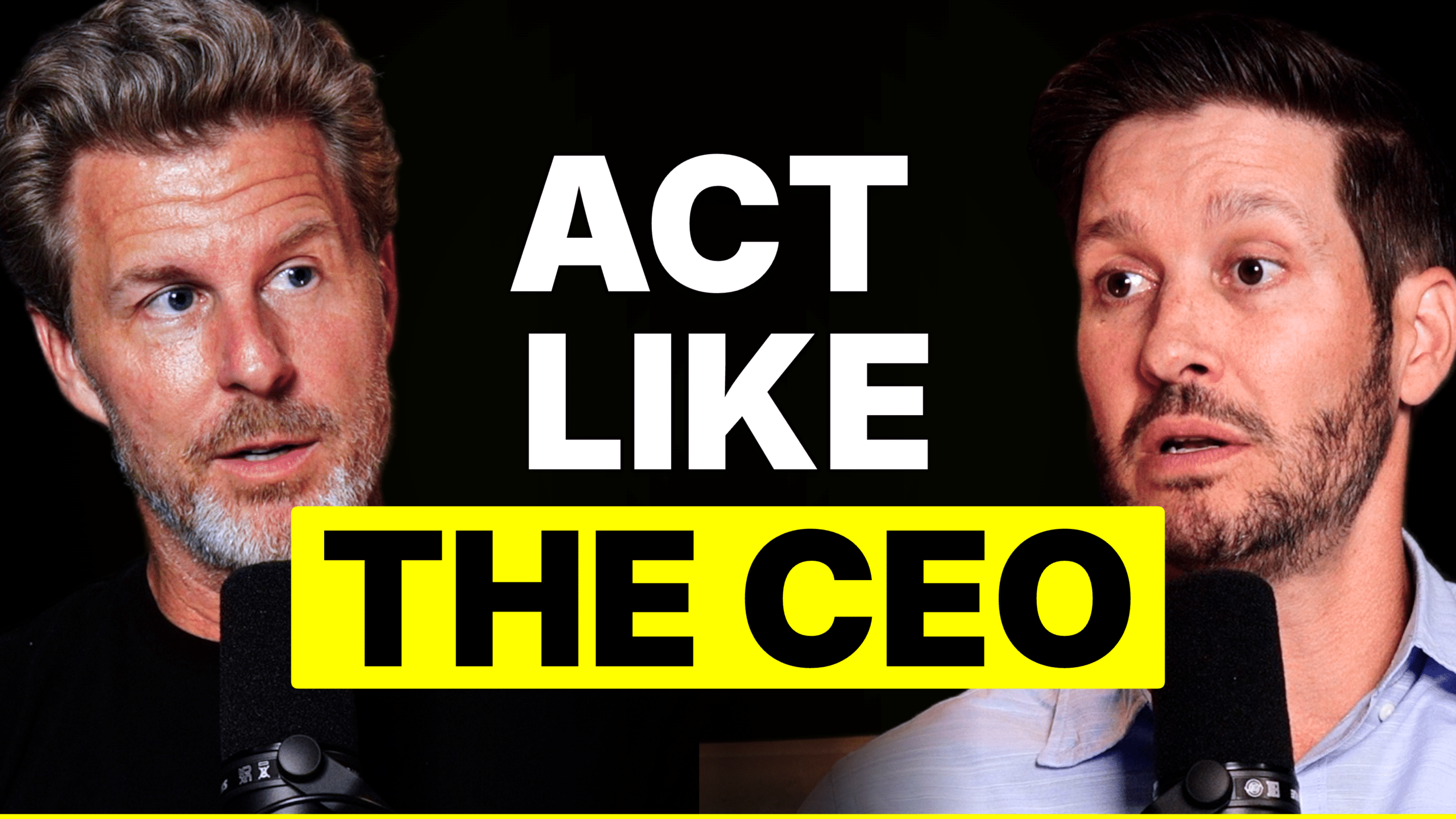
“You need to work on your executive presence.”
Most executives hear some version of that feedback at some point in their careers, and it’s hard to act on because it sounds so vague. What does that mean?
It can also sound like a request to be more formal, or more like somebody else. In this episode of In The Arena, Shaun Dyke and Chris Stemp break down what executive presence really means and how to build it.
Start with a simpler definition: presence is what your behavior does to a room, and putting “executive” in front of it just raises the bar.
There is a core set of traits most organizations expect from their senior leaders. Past that core, it depends on the room, which is why speaking up forcefully can be expected in one company and read as combative in the next. And the person who gave you the feedback usually knows what they meant by it. That makes the most useful next step asking them.
Once you’re a director or a VP, though, asking can feel like admitting you don’t know what you’re doing. Shaun’s experience with senior executives points the other way.
What you’ll learn:
– Why “executive presence” is vague to you but not to the person who says it
– The four core standards: composure, clarity, ownership, and judgment
– Why the better question walking into a room is “How do I create clarity?” and not “How do I get clarity?”
– Karaoke leadership, and finding a version of presence that’s actually yours
– Kendra Scott’s “high care, high bar,” and how a company’s own standards add to the list –
– The most important question Shaun asks in a 360 interview
– What to do when the standard you’re given is a single word like “courage”
– Why, in DoorTwo’s data, only about 10% of people naturally ask for help
– When the feedback isn’t really about executive presence at all
– A real gap, or a perception you have to manage? If you’ve been told you need more executive presence and didn’t know where to start, you’ll come away with four standards to check yourself against and a better question to take back to the person who said it.
⏱️ Chapters
00:00 Told you need more executive presence
02:13 What executive presence actually means
04:20 The four core standards
07:07 Create clarity, don’t just go get it
10:42 Chris’s story, and karaoke leadership
14:11 Handshake, high five, hug 17:47
Too quiet for one room, too loud for another
20:26 The Leadership Chain, and the 30-day hire
23:41 “So what do I do with it?” 29:03 Will asking for feedback hurt you?
32:12 When it isn’t executive presence at all
Connect with us
📩 Have a question you’d like answered on the podcast? Email us at info@doortwo.com
📰 Get the models and frameworks from each episode in writing: https://doortwo.com/signup/
▶️ Prefer to watch? Full video episodes: https://www.youtube.com/@DoorTwo/podcasts
🔔 If conversations about leadership, identity, and growth resonate with you, follow the show.
In The Arena is a podcast about what it really means to live and lead well: the patterns that run us, the scripts we inherit, and the beliefs we reinforce without realizing it. Hosted by Shaun Dyke of DoorTwo.
Shaun (00:00)
This isn’t just a podcast about leadership. It’s about the patterns that run us, the scripts we inherit, and the beliefs we reinforce without even realizing it. We’ve watched this work rekindle marriages, renew parents’ connections with their kids, and reimagine the future of businesses. So if you’ve ever found yourself asking, “Am I becoming the person I’m supposed to be?” you’re in the right place. This is “In the Arena,” conversations about what it really means to live and lead well. Welcome to “In the Arena.” My name is Shaun Dyke, managing partner here at DoorTwo. Joining me today, the illustrious Chris Stemp. How we doing, sir?
Chris (00:38)
Hey, Shaun. Good to be back.
Shaun (00:39)
Always, always. Here’s the scenario for today. I recently started working with a new client. This guy had been in role for at least 10 years, was a successful leader by any right. And as we sat down and I asked him sort of, “Where are you wanting to really expand your impact?” He said, “You know, I keep being told that if I’m going to really progress in my career, that I need to focus on executive presence.” So I felt like that would be a fun opportunity for us to chase this topic ’cause we hear it a lot, but it’s an elusive idea, yet something that I think the vast majority of executives have at one point in their career have heard they need to focus on, build, possess, or need to develop in somebody else.
Chris (01:25)
I’m glad you’re bringing this topic to the table because personally, the idea of executive presence always felt like that was my ticket that wasn’t gonna allow me to go to the top.
Shaun (01:35)
For you?
Chris (01:35)
For me. And the reason is not because I can’t do it, but because it feels too formal, and I don’t do formal. We can go back to personality types, but it’s just like, no, I’m not gonna fake something for your corporate norms. You know? And so what you have talked about here over the years and what we’re gonna talk about today, I imagine, is like what does it actually mean? What is the reality behind that statement, and why do people use that phrase? Because it feels almost just safe. I can say executive presence. It’s ambiguous enough where we can’t nail it down, but it’s specific enough where you will take that feedback and try to work on it.
Shaun (02:13)
It’s a massively generalized concept if you and I just say executive presence. However, I have found that in almost every situation, it’s not generic for the individuals giving the counsel.
Chris (02:23)
Ah.
Shaun (02:24)
So if a senior a senior leader says, “Hey, Chris, I need you to work on executive presence,” they know what that means to them. So let’s do something. Let’s just define it somewhat easily. When we say executive presence, what does that mean? Let’s just cross out the word executive for half a second, and let’s just say presence. You need to work on your presence. Presence in its simplistic definition is what your behavior does to a room. So when you walk into a room, are you aware of how you affect or impact the room through action or inaction? When we put the word executive in front of it we just simply mean we probably have a higher standard of expectation for you. You’re in a spot where we need you to be more discerning about how your presence impacts a room. But that’s very variable depending on the individuals and the environment.
Chris (03:14)
We gotta pause on that because right off the bat then what we’re saying is there is no textbook standard of what an executive should act like.
Shaun (03:26)
I guess to answer the most cleanly your question, so are we then saying that there is no standard? I would say no. I do think there is… there’s a baseline. There is a core. There’s a set of typically commonly desired observable traits that I think we’re gonna wanna sit at the center a little bit. Now, how those manifest and how they plug into the specific environment can be wildly varied. Most people that are in a senior position, one that we would call executive which that term in and of itself is, term is incredibly loose, isn’t it? Because if you’re a nine-person startup and you’re the most senior person in there, you’re the executive in the room, versus if you’re a 30 billion dollar business with global conglomerate and tiers all over the place in a really complex society.
Chris (04:13)
Maybe a leader of leaders or aspiring to be a leader of leaders which are those listening and watching, you know, either end.
Shaun (04:20)
So let’s take a simple one for a second, and we’ll chase one, the idea of composure. You could probably say with a level of consistent confidence that anyone in a position that is an executive, probably a leader of leaders in this space, that you would want them to possess some degree of composure. We don’t want them to be massively erratic, emotional, super volatile, overly reactive to a situation or a scenario. We would hope that they would have the composure to know how to navigate a emotional, volatile, ambiguous situation. Second one would be clarity. An executive knows that part of their job when they are in a room bringing their presence is the continual pursuit of clarity-seeking. If I don’t have the answers on it, I explore to get more answers. I bring curiosity present. I try to understand what it is, that I make sure that my team has clarity of the execution that they need to do. And by the way, I have fallen victim to this countless times. A leader is not good at creating clarity, then there is a material effect on the climate that is a swirl. You know this. One of the core climate dimensions that we lean into heavily is clarity.
Chris (05:32)
Clarity is king.
Shaun (05:32)
So composure, clarity would be two that I would say are really heavily expected as standards. Let me give you two more. Ownership. Not blaming, not complaining. As an executive, you’re in a spot where you have to own the reality of your decisions. You have to own the reality of the outcomes. You have to own the reality of how you are showing up is affecting spaces. So ownership and the willingness to take responsibility. In climate dimensions, if it’s clearly in the state of responsibility, you’re modeling what it looks like to take responsibility for outcomes. Composure critical, clarity, ownership. Last one that I would give, which may sound a little bit weird, it’s judgment. I’m willing to look on a situation and have an opinion, a viewpoint, a judgment on what we need to do here, because you are constantly going to be in a spot where there is no right answer, where clarity is a bit amorphous, and where the team looks at you and says, “What do we do?” And in those spots, if you waffle, if you don’t have a take or a viewpoint, then it’s hard to maintain confidence in the leader because they’re not coming from a place of a strength of conviction or an opinion in it. So, there’s an opportunity for them to demonstrate that. So composure, clarity, ownership, judgment, those four are pretty big. Now, we could probably make another list.
Chris (07:07)
We could. That’s what I was gonna say. You know, what I really like about these is… Are we saying it’s comprehensive? No. We’re saying it’s core, right? It’s base. Also, perhaps outside of composure, perhaps, clarity, ownership, and judgment aren’t seemingly behaviors. You know what I mean? Which the reason that’s good is for all those listening or watching, they get to run it through their lens based on their knowledge of their company and themselves and say, “How can I do that in a way that works?” Which is so helpful because I think too often executive presence, I bet if you go Google it or something, it’s like “Stand up and, you know, do this with your hands.”
Shaun (07:52)
Proper steepling.
Chris (07:53)
And project your voice, all of which is fine. But nobody can lead effectively based on a task list of simple behaviors. But thinking about larger objectives, how do I bring composure into this room? How do I bring clarity? How do I bring ownership? How do I bring judgment? It forces a shift in many people. You go much of your professional career, and you don’t walk into a room saying, “How do I create clarity?” You walk in and go, “How do I get clarity?” So perhaps listening right now, you’re going, “Oh, shit. That’s my executive presence gap.”
Shaun (08:37)
That’s a fundamental shift.
Chris (08:39)
So I just really like that those four aren’t like, “Do this hack.” They’re seek these outcomes which will create the environment that most companies, most successful companies, are calling executive presence.
Shaun (08:55)
Core.
Chris (08:55)
Core.
Shaun (08:56)
So I would say you hear me say this all the time, but I would say the way to think about this is this list is accurate, but it is incomplete.
Chris (09:03)
Incomplete, yeah.
Shaun (09:04)
So those are correct, and you need to build to it. Your example that you just gave, real-world example, coach the CEO of a company, not a small company, huge company, huge brand name. People know this. I’m on the phone with him recently, and he was flying to another country to meet with the team there. And his head space was he was going there, and the team was gonna give him kind of an update on how things are going and how things are moving. He was going to get clarity. And he said, “Here’s what happened that I wasn’t expecting. I go in the room. I sit down.” Of course, we all know this. They’ve spent the last four days prepping the team and everybody else ’cause the CEO’s coming into town, and the person steps up in front of the room, and they said, “We just wanna welcome you, so-and-so. Appreciate it. Would you like to say a few words?” And he had not prepared to give clarity, to guide it, to give a vantage point on where he was. And the group, they wanted that. And it was fun because when I spoke with him, he said, “I felt so foolish afterwards because of course they wanted that from me. Like, that’s what they’re looking for from me in this space, is I’m supposed to walk in and help provide clarity, seek it, explore it with them. And what I went into this doing was trying to get clarity from them.” And it was just a mental shift in that moment that he had it made.
Chris (10:19)
Huge. The again, not to keep going over this, but so much of what we talk about is you don’t always have to have every answer. You have to have frameworks which is what we focus on entirely in our organization, that allow you to think freely and solve for your own based on some knowns, which is so much more personalized. Let me give you a quick story. I don’t You don’t know this one. I was working as a consultant doing a lot of facilitation, a lot of workshops. I was brand new. I was the youngest facilitator in the country. And-
Shaun (10:52)
Congrats, dude.
Chris (10:53)
Yeah, thanks. And I remember joining and being like, “I don’t really know what I’m doing. I have the skills, but I don’t really know what I’m doing, okay?” And so I watched other consultants, and I said, “Okay, just do what they do.” Now, as the youngest, I’m watching people older than me, which is not a positive or a negative, but just different styles.
Shaun (11:14)
Mm-hmm. Mm-hmm.
Chris (11:15)
And I tried to mimic them. and you know me as well, and I don’t do that very well. So I wasn’t doing that well for… at first. I wasn’t getting the results, which is what we’re all here to do. And after a couple months went by, somebody called me up and they said, “We want you to go to this firm. It’s a tech firm. It’s in San Francisco. It’s really young. Just go and have fun.” So I go and I loosen up, and I use my skills, okay, the foundations, these fundamental things but the presence I bring is my version of what I think suc- and it went awesome. And that client became a client for years, and guess what? I became known as like, “Hey, send Chris to the companies who are a little more loose.” And, like, almost overnight, my calendar, my booking, all filled up because I took the foundation of what you have to do to be good at this job- And then decided for the environments I’m going to, mixed with my own personal skillset, what will feel both authentic and effective? And I think that’s where we’re about to go.
Shaun (12:23)
Man nine hundred thoughts is always with this. I always call it karaoke leadership when people are beginning and they don’t really know.
Chris (12:31)
That’s amazing.
Shaun (12:31)
And so they just grab the mic, and then they just sort of try to emulate the what the other person did. And, you know, karaoke leadership can, it can work a little bit.
Chris (12:39)
A little bit.
Shaun (12:40)
You start to figure out, like, “Oh, I can’t hit that note.” “That doesn’t work for me.” “My hips don’t move like that. I don’t know, I don’t know what I’m doing. I’m not Shakira.” Like, you start to learn that is not what I do. And I do think you end up in a spot where you figure out what the authentic expression of that looks like and how do I do that in some way, shape, or form. Because yes, there’s a standard set of how those things show up, and then there’s going to be that environmental space. You know this. We get to do work with Kendra Scott, incredible company, and this is part of what I think we need to link to. They have a set of standards, and this set of standards are the guideposts to help you identify what is executive presence. One of their standards is called high care, high bar, and it is balancing a strong set of expectations and standards for people combined with deep levels of compassion and care for people. So in that space, we talked about this idea of clarity, judgment, composure. Yeah, those are true. Here, you better roll in compassion into it as well. So if you don’t know how to bring compassion present and authentic care and connection with people in it, you’re gonna have a hard time thriving in this environment and bringing executive presence to it. So you don’t just get to run your standard playbook. You would need to adjust a bit inside of that. And leaders that know how to do that well there, thrive. Leaders that struggle with that, it’s hard. It’s awkward for them.
Chris (14:11)
I’d like to walk through kind of where you were going, which is what are some ways to determine, based on your situation, how can I improve my executive presence?
Shaun (14:22)
Yeah. May I share a story? So years ago, I would travel to Boston, and there were three client systems I got to connect with. The first client system was a pretty conservative, pretty historically, I don’t wanna call them rigid, but they definitely had exacting standards. What did that mean? That meant when I showed up there, I was in a suit and tie. So my physical appearance, my gait, my tone, and my way of connecting, it was a handshake. I was a handshake with somebody. I was tonally measured. We sat down appropriately. We had a conversation. We were usually in a boardroom or at a conference table. We exchanged some pleasantries, but we had a very, what would somebody would call serious conversation. Because in that room, that is what executive presence looked like. By the way, that is not how I normally show up. You know this. I had to bring that present, which we’ll talk about that in a minute. I would then leave there, and I would hop in a car, and I would make my way to another location across town. And the people that I interacted with there, it was professional, but it wasn’t a handshake. It was like a high five. it was a little bit more playful. So that meant my tie came off, went in my bag. My sport coat came off, got tucked away in my bag. And when I walked in the room, the leader that I was connecting with could be seven cubicles away, and I could yell over to him, “Hey, Paul, what’s up?” And he would come over, and we would say hi. Now, we still had a professional air about the way we interacted, but there was a different stylistically in how my presence needed to be felt in that room and what was considered sort of socially acceptable and engaging. The last one, I would walk from that location three blocks away to this restaurant company I was working with, and their headquarters was positioned above one of their restaurants. And they were a jeans and T-shirt culture. They were a lot more playful, and they were very relatable. So the first environment was a handshake, the second was a high five, and this was a hug. And so I was honestly, at that point, I couldn’t do anything other than just roll up my sleeves, which was one of the things I would do to change appearance. I didn’t bring another shirt. And so I’d roll up my sleeves, but even that, I was a little bit out of place because that’s not how they were. And so it was hugs and playfulness and connection and how are you doing and laughter and sitting in a very different way I showed up. Now here’s what would be really confusing. If somebody heard you need to increase or you need more executive presence, well, what the hell does that mean? In which environment, with what people, trying to affect what outcome? So executive presence, think of it just as what your behavior does to a room.
Chris (17:11)
I had an aha as you were going through this, which is start with the goal. What environment are we trying to build here? And so that then explains how we need to shift. I need to be able to understand what is the current environment, what is the one they want, how do I create that, what is the environment I typically create. It actually gets a little more complex right away.
Shaun (17:39)
Yeah. It’s a lot more nuanced than what we’re doing. And so-
Chris (17:41)
So those standards you were mentioning, there might be a couple of those, but this is why there’s more to it than that.
Shaun (17:47)
Th- there is. Let’s take it back to that beginning space that I started working with that individual that said, “Hey, I need to,” you know, “more executive presence,” is what I was told. One of the things that we tend to do in any of those situations is we get to ask the question first, which is, do you agree?
Chris (17:59)
Ah, good.
Shaun (18:00)
because if the individual doesn’t agree or they’re out of alignment with it’s actually really difficult to develop somebody towards something that they don’t wanna be developed toward. They don’t have any need present. They’re not interested in doing that. Then there’s a bit of combative-combative-ness around it. In truth, most people we work with are not in a spot… They didn’t get to this spot with this low level of self-awareness that would happen. So this individual said, “I do. I do recognize that.” And I said, “Great. What is it you feel you are missing?” And I let them walk me through some of the elements that they felt like they needed to grow in. Now, we know that comes from a couple different pieces. One is when they look on the world around them and they have somebody that they have as a role model, they create a delta between how they are showing up and how they think others should show up. The second one is, what is the feedback you’ve received that tells you need to build capability or skill in some specific area? And what that does is that helps us then understand more cleanly in that environment with those people what is the thing that they need to be doing differently. So this individual simply was not voicing his opinion aggressively and/or strongly enough. So he was being viewed as passive. So his experience was that he knew he needed to get his voice heard, but didn’t necessarily enjoy it, didn’t like going about it that way. But in that particular environment, the executive demeanor in the room was to be vocal, maybe even combative a little more aggressive with how you were showing up. And if you weren’t doing that, you were being experienced, he was being experienced as meek, which in another scenario or situation, if he brought that kind of presence forward, people would call him combative and disruptive.
Chris (19:57)
I was just thinking that. Imagine if, you know, my wife works… She’s been a kindergarten teacher for a really long time, and imagine you wanna be a principal. And they say, “We need executive presence out of you.” “You’re gonna have a lot of people…” If you come in with that type of energy, you’re gonna have a lot of people you lead, i.e. teachers, being like, “That’s not why I’m in this profession,” right? We’re, we’re not maximizing shareholder value or whatever it might be. So it’s gotta match the environment in this, in this case.
Shaun (20:26)
We’ll, we’ll put it back into this thing that we talk all the time, if you, if we can, if you’re all right with it. We talk about this thing called the leadership chain, right? I’m gonna remind us for those listening and then, and walk it backwards. We say that there’s these causal and connected links. At the end of the day, what you’re trying to do is have your business perform well. In front of that is this thing that we call climate. Climate are the conditions that we create in that environment that directly affects the engagement level and the motivation level of the people to deliver on that good or service. The step that precedes that is leadership behavior. So we know the way a leader behaves has a material effect on the climate. We always call it the weather. You bring weather to the room, if you bring rain into a room all the time, you’re having a wet and soggy adverse effect on the room. The climate is not feeling engaged and supported, excited or reward, and in turn, the material output they put is lower. In this space, executive presence is synonymous with behavior in this change. We’re encouraging someone to increase their awareness of their behavior and the specific behavior these individuals in this environment are calling for to better affect the climate, and in turn, better affect business performance.
Chris (21:47)
Let’s break that down for a minute. The way a leader behaves creates an environment. That environment is gonna modify people’s behaviors. So in this scenario, what we’re saying is your executive presence is the behaviors you do, and we’re defining it or judging it based off the environment you create.
Shaun (22:06)
Ultimately, yes. There’s probably a small nuance in it that says, “Or to fit into this environment.”
Chris (22:11)
Ah, see, that’s two different things.
Shaun (22:13)
Yeah, and I think you can make the linkage, though, that says… One might make the linkage that says, “By fitting into this environment, you will in turn have a better ability to affect this environment.” So client system I’m working with, tech company, Boston-based pretty easygoing group hired a sales executive. Suit, and not just suit, cufflinks. So cufflinks takes it to a different level.
Chris (22:39)
Yeah, sure does.
Shaun (22:40)
So out of the gate, the feedback I was getting was, “He’s not gonna work here. It’s not gonna work.” His presence in his cufflinks because now I’m gonna extrapolate all kinds of things from that it just doesn’t fit here. So no matter how much his tone or approach shows up, he’s gonna be a fish out of water with this. Now, I don’t know that I necessarily agree with that. I think you can have… Wear your cufflinks, wear your T-shirts, wear your boots, whatever you’re gonna wear. However it does, it is interpreted, it is read that you bring present, your presence in a room when you walk into a room that is T-shirt and jeans and you’re wearing suit and cufflinks. It says something.
Chris (23:25)
It’s part of the behavior. Yeah.
Shaun (23:26)
And in this scenario, it’s part of the behavior. It’s part of the presence. And in this scenario, that presence and that behavior was so incongruent with the culture, it felt out of place. He lasted literally, like, 30 days and they all decided it didn’t make sense, he should move on.
Chris (23:41)
Let’s go back to then, and like, okay, this makes sense. I’m understanding it a little more. I definitely don’t yet have the answer to what do I do with it? Because basically what you’ve told me is there’s a few key sets of presence behavior that I should probably make sure I’m aware of, and then the other is entirely dependent on my organization.
Shaun (24:01)
Yeah, which is not very fair, is it?
Chris (24:03)
It’s hard.
Shaun (24:03)
Yeah, so let me give you two head spaces with it. One is when we get to do 360 work, I’m gonna work with an executive. We will do 360 interviews. I get on a call, I spend 30 minutes with folks, and probably the most important question we ask is, “What is the impact Chris has on a room when he comes in?”
Chris (24:22)
You’re essentially asking, “What’s his presence?”
Shaun (24:24)
A hundred percent. And what is his presence doing to the environment, and in turn, you? I then get to hear variations of perfect, engaging, supportive, invites clarity, shuts me down, is defensive, invites swirl, whatever the reality is for the person. So then we get to go back to the person, and we get to walk them through, “Hey, the current presence you are bringing, the executive presence you’re bringing in this situation with these people is doing these things to you.” Now, sometimes that’s really frustrating or disruptive because that wasn’t what happened at the prior company. That was actually the accepted norm or the way of doing things. And that is, I think, this fringe set of behaviors that there is no silver bullet solution to. It is dependent on it. You said this earlier, like, stylistically, executive presence, you don’t wanna work in some corporation that you’re gonna have to do these things. I’m not gonna do that. It’s not who I’m gonna be. So if I’m working with somebody and I say, “Hey I keep getting feedback that you’re just a little too playful and you don’t take things as seriously.” And the individual says like, “Man, that’s just who I am, and I don’t really wanna be anything different than that.” Great. We inform ourselves a lot in that headspace. So there is part of it that is dependent and contingent. And so how do you find those things out? Like so many things in the world, you get to ask. So if somebody says, a senior leader says to me, “Hey, you need more executive presence,” the next question is, or statement is, “Thank you. Appreciate the feedback. May I ask what that looks like for you?” So get some data around it.
Chris (26:01)
Mm. So would you say after we get through these four, th-the common ones we should be working on, so composure, clarity, ownership, and judgment, it would be then look at next what is the environment your company is telling you we want here and we look to build here? And that will typically happen through some type of value statement, culture-
Shaun (26:26)
Competency model, something.
Chris (26:27)
Right? So look at that and say, “What does that mean to me?” Let’s say I do that. Let’s say it’s courage.
Shaun (26:34)
We’ll say.
Chris (26:35)
Okay? What would you then recommend next? This is somebody going “You need to build executive presence,” ’cause oftentimes you don’t get told by doing this. A lot of times people just get told executive presence. So we’re, we’re kinda solving for that for them.
Shaun (26:48)
And maybe even worse, they say executive presence, and then they say the competencies or the standards. Courage.
Chris (26:55)
Bring courage forward. Perfect.
Shaun (26:56)
What the hell does that mean in this environment?
Chris (26:59)
So what would you do then?
Shaun (27:00)
well, here’s what I would say don’t do. Don’t just start throwing a dart. Like, that’s one of the most foolish things to do. Don’t just start trying to figure it out. I don’t know. Let me see here. Let me see what happens. I would, A, mentorship. Seek individuals, your boss in an ideal world. Love it. How do you typically see the expression of courage show up here? What does that look like? And may I ask how you see me doing that in contrast to what optimal would look like? Seek that feedback on it. People are very willing to guide you in it. Second piece is you can also look around the organization for individuals that tend to be thriving, excelling, doing well. This is why… This is a little bit of an aside, but connected to it. When someone promotes someone in an organization, I will say, “That’s awesome. Glad you’re promoting them. So can I clarify what you’re saying is this individual not only demonstrates the results you need achieved, but they also emulate the standards of presence, what you’re expecting out of an executive here?” You can imagine in those spots, it’s always like, “Well, I mean, sort of,” ’cause ideally, you should be able to look at who’s being promoted, who’s moving through the food chain, who is the more senior individuals. And optimally, you can look on them and understand what it looks like to model ownership and clarity and courageousness and compassion or whatever those things are. So you can do it through an observation lens, but your cleanest and most powerful way is literally seeking clarity against, “May I ask you to evaluate me? Where am I against that?” Now, this is a fun one. If you are an exec and you take those questions to another exec, your senior, let’s say you’re on the C-suite, but you are not the CEO, and you take that to the CEO and you ask him those questions, that’s probably gonna be thrown off a little bit. The CEO may not be perfect, or the C-suite member may not be perfect in knowing how to articulate the delta between how you’re showing up and what they need, but it certainly will be enlightening and a dialogue that will allow you to move to a degree.
Chris (29:03)
Okay, I’m gonna ask you a question. You’re not allowed to give a stock answer. You’re not allowed to give the PC answer. You have to use your literal decades working with these people of experience on this. I hear this advice, and I go, “Shaun, my goal is to get in their seat or get two promotions or whatever. I’m not gonna go to them and say, ‘Give me the answers to the test. I don’t know what I’m doing. Help me get better.’” Which is what a lot of people can interpret seeking feedback as. Truthfully, you get to a level, director, senior director, maybe VP. Will it, in most circumstances, negatively impact you if you ask those above you to help fill your blind spots?
Shaun (29:47)
That’s such a fun question. I almost have, like, a violent response to it.
Chris (29:50)
Yeah. And don’t give me the what we should-
Shaun (29:53)
It is-
Chris (29:53)
the real what you see in organizations.
Shaun (29:54)
It is so far to the opposite of what you’re saying.
Chris (29:57)
Really?
Shaun (29:57)
So far. So here’s what we constantly see inside of this. Number one, senior executives want to give you their opinion. They want to develop.
Chris (30:05)
Point.
Shaun (30:06)
They want to share their wisdom. They want to tell you what good looks like. They want to beat their chest and tell you how they did it-
Chris (30:12)
Ah
Shaun (30:12)
to some level. That’s aggressive-sounding that way. But they want to state those truths on how they’re doing. That’s one. Second one, you know this already, in our body of research around this, there is something really simple that defines one of the core…… success factors of executives is the willingness to ask for help. And is that present in me? And you know this in our data sets, 10% of the population naturally scores for the willingness to ask for help because 90% perceive that it looks like weakness. That is a common headspace, and what we find is it could not be more opposite. If I go into a situation, first of all, now let’s be real. If I suck that’s different. But let’s assume I’m already a pretty good performer. I’m executing pretty well, and I come into you and say like, “Hey, I’m conscious. I know where my skills and capabilities are, but I also know that I have room to grow.” “What do you see that is missing in me?” “Is it functional skills gaps that I have? Is it presence gap that I have? Where do you think, based on your experience, I could lean into this situation?” Now, if you do that weekly, that’s different. Now you’re just gonna become an irritant. But if you authentically ask the question around, “Where do you see my opportunity to get better?” they’re going to want to give it to you. By the way, they’ve probably been clamoring to tell you, but most people struggle with giving you direct feedback. So if you create an open space that says, “Hey, I know I’m pretty good here,” and I always advise people to acknowledge where they know their strengths are. Don’t shy away from that. You can say, “Hey, I think I’m pretty effective in these spaces, but I also know, I have enough self-awareness to recognize I could grow in these areas. Where do you see me being better at this, where I could improve specifically in these areas and spaces?” If you do nothing with it, that’s a bit career suicide.
Chris (31:56)
Yeah. If you’ve already been given the feedback, “We’d like you to work on your executive presence,” it’s probably because they think that’s one of the hindering factors in your growth. They wouldn’t say that to you if they were like, “And we don’t want you to get to that level.” So-
Shaun (32:12)
Correct. Potentially chases too far. I just recently started working with somebody where the core thing they told me was executive presence. I’m meeting with HR representative and that person’s boss. I said, “Great. Can you walk me through what that means for you specifically?” And as they walked through it wasn’t executive presence.
Chris (32:26)
Also true, yeah. Yeah.
Shaun (32:27)
It was incredibly low self-awareness, and so the individual was, like, really obtuse in a room. And so they had low self-awareness of how they showed up, and they were showing up as self-interested and arrogant. Well, that’s not executive presence. That’s a core gap in something else that you’re doing. So I mean, this is why we do need to dig into understanding what it is. There’s a difference between me saying, “Chris, I think you could put another layer of polish on you, and you’d be that much better,” than me saying like, “Man, this guy just whiffs every time he’s in a room, so I’m just generically gonna say you need to work on your executive presence.”
Chris (33:03)
You know, one of the things we constantly do, as the one editing a lot of this, is we save the best for last. And I don’t know if that’s good or bad, but I just want to reiterate that because I think it’s critical. If you get this feedback of executive presence, seek answers, ask for it, ask for clarity. We’ll do a quick recap. And also recognize it is someone’s or a few people’s opinion or perspective. Trying to first recognize that always comes through their filter, their biases. And two, what does it mean for you? Because it is possible that it’s not what you think of presence. You know, if we go Johari’s window on us, right, it’s, it’s part that you don’t know about yourself.
Shaun (33:45)
Yeah, blind spot.
Chris (33:46)
Well, Yeah, I’m showing up in a way that they don’t like, but they don’t have either the willingness or the ability to identify that for me, so they couch it under executive presence.
Shaun (33:57)
Something wildly generic. That means I have to be willing to do the dig and work in it. And so some of those core things are standards, and they are stable elements that you need to do. Some of it’s gonna be nuanced. You are right, we tend to do this at the very end, ’cause what I would say in that, like, when I give somebody 360 feedback, I say, “You have a couple jobs here. One is to listen, do your best in that headspace. Number two, at the end of that, you get to determine if this feedback is something you need to act on.” Just because five people have told you that you need to be better at this may or may not be true. Once you then determine, “This is something I need to act on,” you now need to go through another filter. Is this a real gap, or is this a perception? Because somebody might say, “Well, here’s a challenge. You know what?”
Chris (34:40)
So good.
Shaun (34:40)
“Chris has never played baseball. He doesn’t know how to play.” Now, we know that’s not true. We know Chris knows how to play. It’s just they may never have observed it in you. So now you either have a skill that you have to close or a perception you have to manage.
Chris (34:52)
We’re wrapping this up here. A lot of the things we talk about, kind of the self-awareness, building that self-awareness to change behavior to create the climate you want, there is no quick answer.
Shaun (35:03)
No. That’d be nice, wouldn’t it?
Chris (35:04)
But if I’ve listened to all of this and I have some ideas, first, I better understand what executive presence mean. Second, I realize there are the four kind of common, let’s look at those. Third, I say, “Let me look at what my company values, either written or unwritten.” And fourth, “Let me go ask for specifics.” Those are kind of the four things we’ve talked through.
Shaun (35:23)
I mean, you’re gonna be well-informed if you do that.
Chris (35:25)
That’s fair. And then act on it. Big one, right? We can’t force you to that.
Shaun (35:30)
Hundred percent, yeah.
Chris (35:30)
You’ll probably make the necessary improvements.
Shaun (35:32)
Material impact. Number one, just in asking, you’re demonstrating a desire to grow. And so all of a sudden, the interpretation or experience of you is a growth mindset. They wanna grow. They wanna be better. They know where they’re good, but they’re also willing to know where they’re not. We always say, “All growth starts with self-awareness.” We don’t say it ends with self-awareness, though. Right? You also have to add in some other awareness into this equation in growth. And so if you’re asking folks these thoughts, they’I mean, that’s, that’s a powerful way to demonstrate that you genuinely are trying to grow in your capability set. They’re probably gonna give you some things. You make material effect on one or two of those, it’s fundamentally gonna shift the way in which you’re being experienced. And so intentionally working on those authentically in a way that allows your presence to affect a room in a more positive way, modifying the climate, adjusting the behavior, and in turn, delivering performance results.
Chris (36:28)
I mean, I don’t know, but I think we just put a solution to one of the most ambiguous and often asked questions that we see. So, Shaun, thanks for lending your wisdom, your experience, and your many times having this conversation here to this podcast.
Shaun (36:41)
Super fun, man. Always.
Chris (36:42)
Appreciate it. Thanks for joining us in “The Arena.” If you wanna keep growing, the best thing you can do is join our weekly newsletter. It’s where we break down the biggest ideas from the podcast and share the tools and frameworks we use every day to help leaders live and lead differently. You can sign up for that at doortwo.com/signup. That is D-O-O-R-T-W-O.com/signup. And if you enjoyed the conversation, make sure to follow or subscribe wherever you listen. If you prefer to watch, head over to YouTube and check out our full video episodes filmed right here in our on-site studio. And remember, all growth starts with self-awareness. We’ll see you next time in “The Arena.”